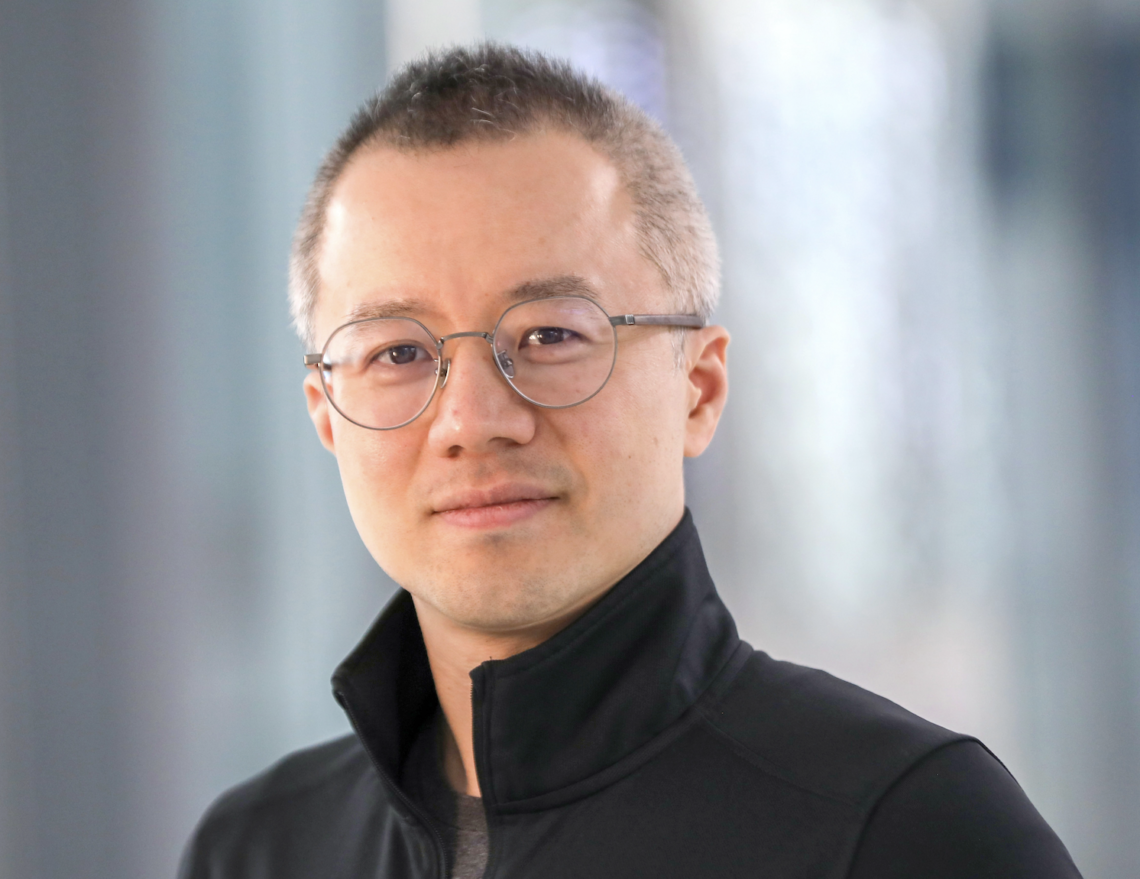

GenBio AI is building an AI system that can simulate how cells respond to a wide variety of genetic, chemical, and environmental interventions. Its multi-scale world model-based system aims to obtain a global view of the underlying biology of living cells, tissues, and organs to unlock biological and biomedical discovery with applications ranging from basic research to translational medicine and drug discovery. Dr. Song Le, the startup’s CTO, was a speaker at the World Economic Forum’s Annual Meeting of the New Champions in Dalian, China. The Innovator’s Editor-in-Chief caught up with him there.
During the conference, which took place June 23-25, the startup announced a new collaboration with Nvidia, the American maker of chips used to train and run everything from large language models to AI-powered drug discovery tools. GenBio AI plans to leverage Nvidia’s chips, model-development tooling, and agentic framework as part of a broader stack for scaling autonomous model construction and high-throughput virtual cell experimentation.
“We are producing world models that run on Nvidia’s hardware to help pharmaceutical companies build better AI models and do better simulations with the data they have now,” says Song, reducing the one to two months of time it would take human researchers to two days. “We can take their current data and get more out of it,” he says.
Building one good cell model requires researchers to spend countless hours manually designing architectures, tuning dozens of settings, fixing problems, and testing ideas, says the startup. This process can take months of expert iteration with no guarantee of a useful result. To close that gap, the GenBio AI team built a new technology: VCHarness, an autonomous agentic system for constructing virtual cells. Rather than relying on human researchers to design each model by hand, VCHarness does the work autonomously: it proposes a candidate model, writes the code, runs the experiment, measures the results, learns from what worked and what didn’t, and tries again — all in a continuous loop.
The system combines a library of pre-trained biological foundation models (covering the DNA, protein, RNA, and cellular levels) with AI coding agents, structured search, evaluation, memory, and distributed execution to generate, test, debug, and refine candidate virtual cell components. Together, these allow VCHarness to efficiently search over complete executable modeling workflows and learn from experimental results, going from biological question to validated model candidate in a fraction of the time previously required, according to the company. By combining GenBio AI’s virtual-cell world-models and autonomous model-building technology with Nvidia’s accelerated computing and BioNeMo ecosystem, the companies aim to make life-science R&D more scalable and reproducible.
But GenBio’s ambitions are much bigger. To discover and develop new medical treatments, researchers must understand how living human cells respond to a wide variety of changes: what happens throughout the system when a gene is switched off, a drug is introduced, or a disease disrupts normal function? With conventional methods, this is extraordinarily difficult, says GenBio AI. Of every 10,000 compounds entering the drug development pipeline, only one on average reaches the clinic, because human biology is incredibly complex and existing tools capture only fragments of it.
A virtual cell world model (VCWM) is a simulation engine built to solve this problem. Through its world model architecture, GenBio AI aims to help biologists to predict, simulate, and ultimately program cellular processes across all biological scales, molecular and cellular. Think of it as biological intelligence. The goal is to enable deeper understanding of disease mechanisms, faster testing of therapeutic hypotheses, and better evaluation of candidate interventions in a digital laboratory before any physical experiment is run.
World models, an AI-driven generative system that produces possible future states of an environment conditioned on actions, enabling simulation and reasoning over trajectories rather than static predictions, promise to make this possible. When applied to biology, a world model of the virtual cell becomes a generative system that simulates the space of biological possibilities for a given cell type under arbitrary natural or artificial interventions, at both single-cell and population levels.
“By capturing that level of complexity, we hope to be able to predict the entire human response to a drug in the next ten years,” says Song. A systemic view of how treatments will impact an individual’s body will eventually help usher in personalized medicine, he says. “We are not there yet but we are getting closer.”
The potential impact on drug discovery and basic biology is expected to be substantial, going far beyond what has been achieved by AlphaFold, an artificial intelligence system developed by Google DeepMind that predicts not just protein structures but also how proteins interact with DNA, RNA, and small-molecule drugs. That work was significant enough that Demis Hassabis and John Jumper, AlphaFold’s lead developers, shared the 2024 Nobel Prize in Chemistry. But AlphaFold is limited to proteins and molecules, says Song. GenBio wants to decipher how not just proteins but all of the biological layers interact with each other and manifest in cellular responses.
“If realized, the Virtual Cell will not simply accelerate experimentation, but may transform how biological possibility is explored, shifting discovery from exhaustive search to structured navigation within learned cellular worlds,” Song and GenBio AI President and Chief Scientist Eric Xing wrote in a research paper published in May. “More broadly, this paradigm points toward a transition of biology into a computational and design-driven discipline. Just as computer-aided design (CAD) facilitated architecture and mechanical design, electronic design automation (EDA) revolutionized semiconductor engineering, and large-scale simulation underpins modern weather prediction, Virtual Cell world models may become the computational substrate for biological design. In this view, simulation and computational reasoning become integral to decision-making, guiding experimentation, intervention, and engineering, and bringing biology closer to an industrial age of predictive design and programmable systems.”
GenBio AI was founded in 2024 and is headquartered in Palo Alto, California, with satellite labs in Paris and Abu Dhabi. The company is currently preparing to raise a Series A round of financing.