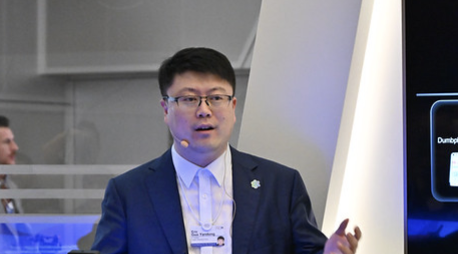

Yangdong “Eric” Guo, PhD, has a personal robot assistant that makes him coffee and tidies his office. If he has his way, everyone else will too.
“Our mission is to enable every industry, and every individual, to have robots as assistants,” Guo said in an interview with The Innovator.
Guo is a founder and CEO of AI2 Robotics, an Artificial General Intelligence (AGI) general-purpose robotics company. The Shenzhen, China-based company builds both the hardware and the frontier vision-language-action models that operate the machines, providing the spatial reasoning and intelligence that allow robots to see, comprehend the world and act without needing manual operation.
The company is working on actively commercializing its technology across multiple environments, including industrial, biotech, public services, retail, elder care and healthcare.
AI2 Robotics is one of a small number of players that combines model research, hardware design, manufacturing and deployment services in-house, rather than specializing in just one layer of the tech stack. “We are very different than most other robotics companies,” says Guo. “They use different hardware for different applications, then write the software or train small expert models to fit a scenario. We have a completely different philosophy. We make general purpose hardware and one foundational model.”
The Chinese scale-up hopes to widen uptake of its technology by opening parts of its stack to outside developers, positioning its foundational model as both a commercial product and platform for the broader embodied-AI community. Think of it as the “Android of robotics,” says Guo.
Why Capital Is Flowing into This Space
At the end of June, just days after The Innovator caught up with Guo at the World Economic Forum’s Annual Meeting of the New Champions in the Chinese city of Dalian, AI2 Robotics secured a reported $735 million in fresh funding that pushed its valuation past RMB 50 billion (about $2.8 billion). The raise was announced the same day as a comparable round for Shenzhen-based rival X Square Robot, which crossed the same $2.8 billion valuation threshold after four consecutive financing tranches. Press coverage framed the two announcements as China birthing two robot unicorns in a single day.
The June rounds arrived in the same window as blockbuster raises at U.S. robotics companies. These include Apptronik’s $935 million round, giving the company, which is backed by Google, Mercedes-Benz and John Deere, a $5.5 billion valuation, and Agility Robotics’ SPAC merger, which is expected to raise over $620 million. All four announcements underscore how much capital is flowing into humanoid/embodied AI hardware globally right now, even as U.S. and Chinese players pursue different routes to scale: private mega-rounds and SPACs in the U.S.; a high cadence of smaller, frequent rounds in China.
AI2 and the other robotics companies are embodiments of “physical AI”, AI models that are connected to sensors (cameras, microphones, force/torque feedback) and actuators so that software can perceive, reason about and act on the physical world, rather than only processing text or digital data. Advances in technology are making Physical AI the next big thing in AI, which explains why AI/humanoid robotics is becoming one of the most heavily capitalized corners of the AI industry this year. Competitors include a crowded field of Chinese rivals — Agibot, Unitree Robotics, UBTech Robotics, and Galbot — as well as U.S. makers of bipedal humanoid robots such as Figure AI, which has a valuation of $39 billion, and Apptronik.
Key Differentiators
AI2 Robotics’ pitch is that it is extending AGI-style capability from the purely digital world into physical labor and it has built its product architecture around three deliberate choices that distinguish it from many rivals.
- A Wheeled-Humanoid Hybrid: Rather than building a fully bipedal walking humanoid (the approach taken by Unitree, Figure AI, Tesla’s Optimus ,Agility’s Digit and others), AI2 Robotics’ AlphaBot pairs a humanoid torso and arms with a wheeled base. The company’s stated rationale is industrial-grade stability, speed and safety: a wheeled base is markedly less prone to toppling than a bipedal one, and it sidesteps some of the regulatory and safety-certification hurdles that pure bipeds face when moving into public-facing or safety-sensitive environments — while still allowing the upper body to perform high-precision, human-like manipulation.
- An in-house, full-stack foundation model: AI2 Robotics has developed its own vision-language-action (VLA) model designed for full-space understanding, whole-body coordination and complex multi-step task reasoning. This is the software layer that lets AlphaBot interpret open-ended natural-language commands, plan a sequence of physical actions, and adapt to new environments and objects it has not been explicitly trained on, rather than executing pre-scripted motion routines. “Our foundational model can learn things very fast,” says Guo. “It helps robots to accumulate new knowledge and keep learning to get better performance in different scenarios.” For example, he says if a robot learns to push a cart in an airport, the accrued knowledge will help it to move a cart in a factory. “Without a foundational model a robot would treat this as a different task,” he says.
- A closed loop between data, hardware and commercial deployment: The company describes its edge as a “Model × Hardware × Scenario” system: robots deployed in real commercial settings (an airport, a factory floor, a retail store) generate operational data that feeds back into training the next model iteration, which is then redeployed into hardware built and manufactured in-house. AI2 Robotics frames this “data closed-loop plus scenario compounding” as its most durable competitive advantage, on the logic that real-world deployment data is harder for rivals to replicate than any single piece of hardware or software.
Individual Robot Assistants in Every Home, Office and Factory?
AI2 Robotics wants to make robots as accessible as smart cars and smartphones, becoming a universal device for everyone. Guo believes mass market uptake is only five to seven years away. The cost of a robot assistant is around $50,000, the price of a car, and will get lower as volumes increase, he says.
The case for their use is strong, he argues. Factories are facing labor shortages. Robots not only fill the gap; they can work 24/7. They are fit for dangerous or unpleasant tasks and, as he is learning, can be helpful around the office, making coffee, erasing whiteboards and tidying up. Robots will be in everyone’s homes, he says. “If you don’t feel like cooking and don’t want to clean dishes a robot is perfect,” says Guo. The American animated TV series The Jetsons envisioned we would have robotic household help by 2062. If AI2 Robotics has its way, we won’t have to wait that long.