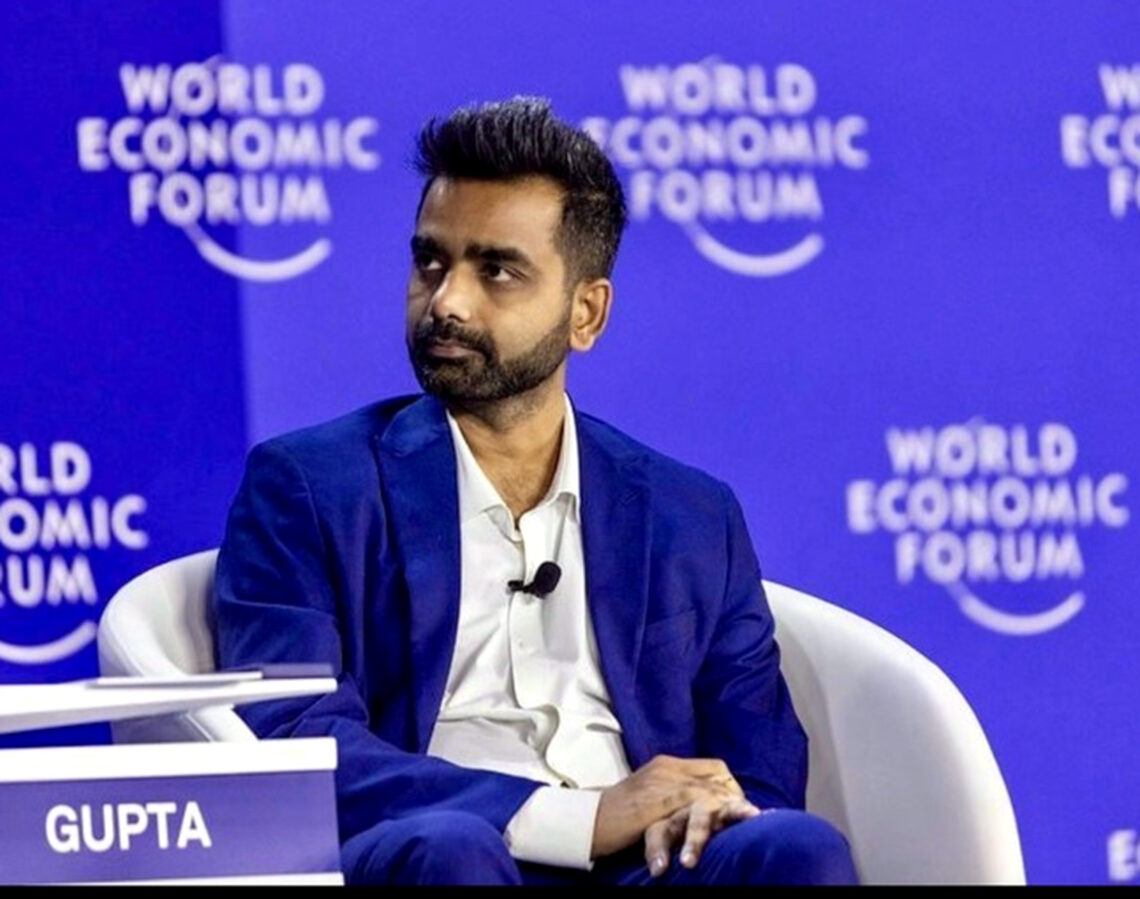

Himanshu Gupta, the co-founder and CEO of ClimateAi, is a climate‑tech entrepreneur and AI leader, who advocates for using artificial intelligence to create equitable, climate‑resilient futures. He co‑founded ClimateAi in 2018, while completing his MBA at Stanford University, building the company into the world’s first climate resilience platform, which was recognized by TIME Magazine as one of the best inventions in 2022. As CEO, he leads a team of scientists and engineers who apply machine-learning models to help accelerate solutions to climate adaptation. These models have created a positive ROI for many Fortune 500 businesses and over 10 million farmers. Gupta received the highest civilian honor for his home state in India from Chief Minister Yogi Adityanath and the Vice President of India. Before ClimateAi, Himanshu worked with U.S. Vice President Al Gore and economist Lord Nicholas Stern on global climate initiatives. He served as India’s lead emissions modeler, contributing to the Paris climate discussions. Gupta was a speaker at the Forum’s Annual Meeting of the New Champions in Dalian, China. While in Dalian he also spoke on a panel at a side event organized by Frontiers, the open science publisher, on how emerging technologies will impact climate and sustainability moderated by The Innovator’s Editor-in-Chief. He agreed to be separately interviewed by The Innovator on the same topic.
Q: ClimateAi’s forecasting platform has reportedly created positive outcomes for over 10 million farmers. What does that translate to in concrete terms?
HG: It translates into better resilience outcomes for farmers (faster, cheaper adaptation) and a high ROI for input and food companies that work directly with farmers. We reach farmers indirectly, through the food, seed, and agri-businesses whose supply chains they sit in, and the platform turns a climate signal into a specific action. Concretely: a seed company can narrow down which drought- or heat-tolerant variety fits a given geography in hours, instead of multi-year field trials leading to 17x ROI for the seed companies and faster and cheaper access for farmers to climate-resilient seeds. A sourcing team gets months of lead time on a difficult season and can move volume earlier. One example I can share: when we modeled long-run heat and drought stress for a tomato-growing region in India, the projected output hit was serious enough that our seed partner accelerated the development of drought-resistant varieties for smallholders there. I won’t claim we caused any single farmer’s outcome — we’re one input among many — but the decisions we change are concrete: which seed, which planting window, which sourcing region. That’s the unit of impact I actually care about.
Q: Your platform focuses on food, water, and energy security. Where are you seeing the biggest demand right now, and is that different from where you expected the market to be?
HG: Food and agriculture are where the demand is sharpest, and partly by design, the pain there is physical and quantifiable. When a food or beverage company’s key growth region has a bad year, it shows up in availability and cost, and thus impacts their bottom line. Water sits right behind it and usually arrives through the same door: once you’re forecasting a crop, you’re forecasting the irrigation and water availability it depends on. What genuinely surprised me is who is asking. I expected to be selling to sustainability teams when we launched the company 8 years ago. Instead, the demand increasingly comes from procurement, operations, and finance — the people with a P&L. That tells me adaptation has crossed from a “green” line item to a core business-planning one. That’s exactly where it needs to be.
Q: AI is itself an enormous and growing consumer of energy. How do you reconcile building an AI platform to address climate change while the infrastructure powering it contributes to the problem?
HG: I’d push back gently on the premise that all AI carries the same energy cost. The image people hold is a giant general-purpose model burning a small country’s worth of power. That’s not what climate adaptation needs, and it’s not what we build. We lean on physical science to constrain our models, which lets us use far smaller, purpose-built systems instead of brute-forcing it with parameters. My rule internally is almost boring: start with the problem, ask whether it even needs AI, then use the simplest model that solves it.
And I’d be honest that the right way to judge any AI system is its net effect, which depends entirely on the use case. A purpose-built model that helps a grower cut fertilizer or water use, or helps a utility plan for a heat wave, can save more than it costs to run. A giant model used carelessly on a problem that didn’t need it is the opposite. The danger isn’t AI using energy — it’s oversized AI used without that discipline. We should hold ourselves to the efficiency standard we hold everyone else to.
Q: Which emerging technologies outside of AI do you think are most underrated in the climate conversation right now — and which is five years closer to deployment than most people realize?
HG: Two, and neither is glamorous. The first is gene-edited, advanced-bred, climate-resilient crops. The tools have matured to where a drought- or heat-tolerant trait can be developed far faster than the old decade-long cycle — and pairing that with forecasting is powerful, because you can target the trait a region will need before the stress arrives. People still file this under the old “GMO debate”; I think it’s much closer to a frontline adaptation tool than that framing suggests. The second is long-duration energy storage. Most planning has priced in lithium-ion for a few hours of shifting; the underrated leap is iron-air and thermal systems rated for far longer — Form Energy’s iron-air, for instance, targets on the order of 100 hours. Multi-day storage is the piece that lets a renewables-heavy grid ride through a long stretch of low sun or wind. I spent my early career modeling India’s energy scenarios — storage duration is the variable that moves those curves the most.
Q: You’ve worked at the highest levels of climate policy — the Paris Agreement, India’s National Five-Year Plan. Does AI actually accelerate policy change, or does it risk letting governments off the hook by making adaptation look manageable?
HG: Having sat on that side — I helped model India’s emissions for Paris and wrote the renewable-energy chapter of one of our Five-Year Plans — I’m wary of both extremes. AI doesn’t pass laws, and it doesn’t fix the politics, capital, and institutions that actually stall climate policy. What it can do is reduce a specific kind of uncertainty: how a changing climate will hit a particular district, crop, or grid, at the resolution a finance minister or a mayor actually plans at. That makes some decisions easier to justify and harder to defer.But your worry is the right one. Better adaptation data must never become a license to slow mitigation — that’s the trap. The way I hold both: adaptation buys time and political room to decarbonize; it doesn’t substitute for it. And when a government sees the modeled cost of a hotter world for its own economy, that should sharpen the case for cutting emissions, not soften it.
Q: Fortune 500 companies are paying for climate resilience forecasting. Is the business case for climate adaptation now self-evident, or are you still having to make it?
HG: It’s self-evident to the front-runners and still a sell to everyone else — normal for any new category. What’s changed is the argument we lead with. I used to talk about risk: avoid the loss, protect the asset. Now we lead with the competitive advantage argument. The example I point to is a building-materials company that acted on our forecast ahead of Hurricane Ian and pre-positioned roofing in the storm’s path — about $15 million in additional revenue in a single season.
In the macro case, studies of adaptation economics — including the Global Commission on Adaptation — put the return on well-chosen adaptation investment at roughly 2-to-1 to the high teens by 2050, depending on the category and the baseline. I won’t pretend any of those are guaranteed; they depend on the intervention. But the direction is clear enough that the question for a CEO is no longer whether climate change is real. It’s the practical one: how does this hit my supply chain, and what do I do about it before my competitor does?
Q: There’s a risk that AI tools give companies a way to manage climate risk on paper — better forecasting, better reporting — without actually reducing emissions. How do you guard against ClimateAi becoming a sophisticated form of adaptation theater?
HG: By refusing to let it stop at a report. Adaptation theater happens when the deliverable is a disclosure—a tidy risk map that goes into an annual report and changes nothing. We tie every output to a decision and a number: a seed switched, a sourcing region moved, a planting window changed, revenue protected or won. If a customer can’t point to the decision our forecast changed, we haven’t done our job — and our contract won’t be renewed.
On the broader question, yes, companies can use better forecasting and reporting to manage while emissions keep climbing. I’ve argued that those most responsible for emissions should help finance adaptation where the damage lands hardest. To be clear, I don’t mean an offset or a license to keep emitting — it’s additional finance, on top of cutting your own emissions, never instead of it. Adaptation and mitigation are not substitutes. Anyone selling resilience as a way to stop worrying about your carbon footprint is selling exactly the theater you’re describing.
Q: What is your message to senior executives?
HG: Climate change is one of the top three risks facing the global economy, as highlighted by the recent WEF report. At the same time, climate adaptation is one of the biggest market opportunities of our lifetime to increase market share, improve P&L, and the lives and livelihoods of people in their value chains.