
Picture a biopsy taken on Monday. By Tuesday it’s sequenced. By Thursday, a lab has designed a vaccine built from that patient’s tumor alone — genetic instructions that didn’t exist days earlier. By week’s end, doctors are administering it. Down the hall, another patient with the identical diagnosis waits for a completely different vaccine, designed around a different tumor, because the same diagnosis no longer needs to mean the same treatment. Instead, the biology of each tumor can now define the vaccine designed to target it. The vaccines keep cancers such as those that attack the skin, lung, and pancreas, in check and prevent them from recurring. This is the future projected for personalized mRNA cancer vaccines by 2031 — and the early data suggests it is possible.
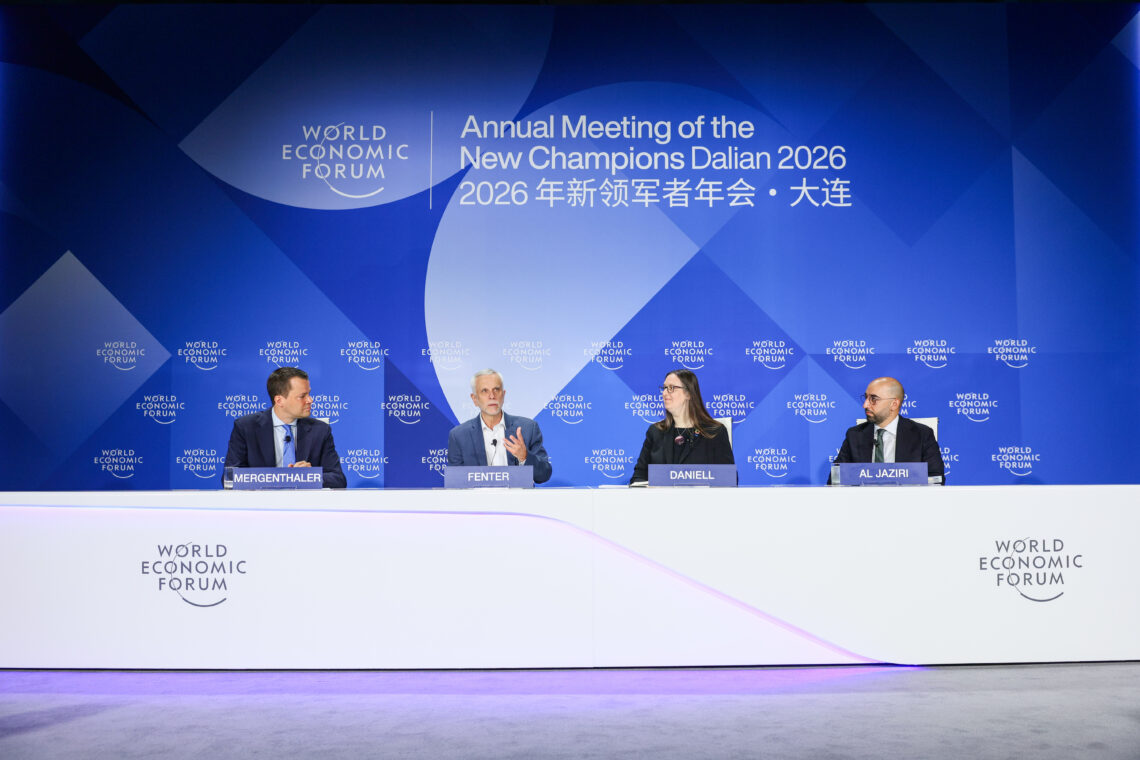
mRNA cancer vaccines are one of the ten emerging technologies of 2026 identified in a report by the World Economic Forum, in collaboration with Frontiers, the open science publisher. The report, now in its 14th edition, was launched on June 23 at the Forum’s Annual Meeting of The New Champions in Dalian, China, during a session that included Fred Fenter, Frontiers’ Chief Executive Editor, as well as Stephan Mergenthaler, Managing Director, Chief Technology Officer, World Economic Forum, Abdulaziz Al Jaziri, Deputy Chief Executive Officer, Dubai Future Foundation and Katherine Daniell, Director, School of Cybernetics, Australian National University. (Jennifer L. Schenker, The Innovator’s Editor-in-Chief, is moderating two panels at a June 24 side event in Dalian organized by Frontiers that will look at the impact of these emerging technologies on the future of work, climate, and sustainability.)
The top ten emerging technologies are not yet here, says the report, but are approaching the moment when decisions made by governments, industry, and research institutions will meaningfully shape how they arrive in the world.
The other top emerging technologies are: everything-to-grid (buildings, vehicles, and devices become a place that can store power, return it, and help balance supply and demand in real-time, turning the grid into a network of intelligent nodes); direct lithium extraction; passive radiative cooling materials; forever chemicals (PFAS) destruction; precision fermentation; exosome drug delivery (using the body’s own couriers to deliver medicine); world models (AI that can think and act in three dimensions) and lattice-based cryptography to protect today’s computers against tomorrow’s technology.
How mRNA Cancer Vaccines Work
Rather than attacking cancer directly, mRNA vaccines teach the immune system to recognize it: doctors sequence a tumor’s mutations, identify the proteins marking those cells as foreign, then synthesize a vaccine around that exact profile.
Results are already striking. A six-year Memorial Sloan Kettering trial found a 90% survival rate among pancreatic cancer patients whose immune systems responded to the therapy — a disease that up to now has had a five-year survival rate of just 12%. A separate trial pairing a personalized vaccine with immunotherapy cut melanoma recurrence or death by 49%, enough to advance to Phase 3.
“We are lucky to live in a time when these developments are coming very fast,” Dr. Rita Carsetti, a contributor to the report and President, International Union of Immunological Societies (IUIS); Head, B Cell Lab, Immunology Research Area, Bambino Gesù Children’s Hospital, said in an interview with The Innovator.“We are trying to use new therapies on many types of cancer. Look at leukemia. Ten years ago, many were dying but today 90% of them will survive without complications. This is due to the new therapies that have changed the history of the disease and give many more people a chance of survival.” mRNA cancer vaccines are poised to further increase the chance of recovery for patients of different kinds of cancer by personalizing treatment, she says.
mRNA personalized cancer vaccines are tailored to each patient’s unique tumor. Doctors sequence the patient’s tumor DNA to identify “neoantigens” — mutant proteins specific to that cancer — then encode those targets into an mRNA sequence. When injected, the vaccine trains the immune system to recognize and attack cells displaying those markers. These vaccines utilize different types of RNA to create personalized treatments tailored to each patient’s unique tumor.
A tumor embodies several thousand mutations, explains Prof. Dr. Peter Brossart, Director of the Medical Clinic and Polyclinic III, Department of Oncology, Hematology, Immuno-oncology, and Rheumatology, University Hospital Bonn, a contributor to the Forum report. “That is why you need to sequence the whole tumor to find the new antigens that are really capable of eliminating malignant cells,” he said in an interview with The Innovator. “We now have the technology to do that. The more antigens we can target, the better the immune response. In future we will combine vaccines with other treatments.”
Why Now?
Advances in tech and science that are contributing to personalized cancer vaccines include:
- AI for neoantigen selection: Artificial intelligence is helping scientists identify the best cancer targets, while manufacturing improvements have reduced production time.
- Lipid nanoparticle (LNP) delivery: Derived from COVID-19 vaccine technology, LNPs are the primary delivery mechanism, though researchers are working on improved formulations to better target tumors and reduce off-target effects.
- Combination therapies: There is strong biological rationale driving rapid expansion of trials for cancers such as melanoma combining mRNA vaccines with anti-PD-1/L1 checkpoint inhibitor agents.
Timing is also playing a key role: two decades of genomics progress colliding with the mRNA manufacturing and regulatory infrastructure the COVID-19 pandemic built almost overnight, backed by an estimated $79.4 billion in public investment.
A $200 million NCI partnership announced in March 2026 suggests the field has moved past proof of concept — toward the harder problem of delivering, at scale, a medicine where no two doses are ever the same. That promise comes with a catch, though: early treatments could exceed $100,000 per patient, a price tag that the report says risks confining the most advanced cancer care to a limited number of people in well-resourced health systems, widening global gaps in cancer outcomes.
Putting Cancer Vaccines to the Test
The field is supported by over 120 ongoing clinical trials, with over 60 treatments in development and first commercial approvals expected by 2029. Trials of mRNA cancer vaccines are underway in China, with companies such as Stemirna Therapeutics, NeoCura, and Everest Medicines among those active in the field.
In Western countries, the most advanced program is being led by Moderna/Merck. The company reports that in a Phase 2b trial, spanning multiple centers across the U.S. and Europe, patients with high-risk melanoma received a personalizedvaccine alongside pembrolizumab, a widely used immunotherapy. The combination reduced the risk of recurrence or death by 49% compared to immunotherapy alone, a result strong enough to advance the combination into Phase 3 trials, now under way.
Phase 3 studies in non-small cell lung cancer and Phase 2 trials in renal cell and bladder cancers are also ongoing.
Meanwhile, a personalized mRNA vaccine called autogene cevumeran — jointly developed by BioNTech and Genentech and tested in a Memorial Sloan Kettering Cancer Center-led trial — demonstrated remarkable efficacy in pancreatic ductal adenocarcinoma (PDAC) patients, with vaccine-induced immune responses persisting for nearly four years after treatment in some patients and showing a reduced risk of cancer recurrence at three-year follow-up compared to non-responders. This is significant because pancreatic cancer has historically been one of the hardest cancers to treat, with a five-year survival rate of only around 12%.
LungVax, developed by researchers at the University of Oxford, the Francis Crick Institute and University College London with funding from Cancer Research UK and the CRIS Cancer Foundation, is poised to become the world’s first experimental preventive vaccine for lung cancer, with clinical trials scheduled to commence in 2026. It aims to intercept cancer development by identifying and clearing precancerous lesions.
mRNA cancer vaccines are additionally being tested on colorectal cancer.
“We have to wait until results from Phase 3 trials,” says Brossart, but he is optimistic that the personalized mRNA vaccines will prove an effective weapon in the war on cancer.
The Challenges Ahead
To scale mRNA vaccines will have to overcome a number of challenges including cost, manufacturing complexity, and new regulatory pathways.
Creating vaccines that must be custom-built from a patient’s own tumor biopsy, would change the economics of an industry built around scale. Pharmaceutical companies would need to create a second production model alongside conventional drug development, notes the Dubai Future Foundation, a contributor to the Forum report. Standardized immunotherapies and targeted agents would continue to be developed for patient populations and manufactured at scale, while a personalized layer is built around one patient at a time.
Regulatory pathways must be established before submissions for regulatory approval are filed between 2026 and 2029. Regulators will need to evaluate a process rather than a single identical product, since no two doses are the same.
Insurers and national health systems will need to price treatments for a single patient, notes the Future Foundation in the report. Delivering at scale will require sequencing, design, and manufacturing to work as one pipeline, rather than as separate handoffs between labs, vendors, and hospitals.
Hospitals will need on-site or partnered sequencing capacity, computational design that can turn a tumor profile into a vaccine sequence in hours and manufacturing able to produce thousands of individualized doses each month, rather than millions of identical ones, says the report.
The relationship between diagnosis and treatment would also change. “A biopsy would no longer only identify disease; it would become the input that determines the medicine a patient receives,” says the report. “If the immune response trained by the vaccine persists after treatment, the body may be better able to detect returning cancer cells, changing what survivorship means and how patients live after diagnosis.”
Access is the central risk, the Dubai Future Foundation says in the report.The vaccines remain expensive, currently costing over $100,000 per patient. Analysts project personalized vaccines could ultimately command up to $300,000 per patient. The hope is that the cost will eventually come down and that in the meantime enough similar antigens can be identified for certain types of cancers that hybrid off-the-shelf mRNA cancer vaccines could be developed, says Carsetti.
Shared neoantigen libraries and hybrid models that combine personalized and off-the-shelf mRNA cancer vaccines could help balance cost, speed, and specificity, particularly for health systems unable to manage the full sequencing, design, and manufacturing process themselves. “We will have to find balances between what is optimal and what is possible,” Carsetti said in an interview.
The Big Picture
This year’s cohort of emerging technologies underscores how value is migrating from what can be manufactured at scale to what can be produced at the point of use, notes the report. In the past, pharmaceutical blockbusters, centralized energy generation, and commodity-scale food production were all built on the assumption that value accrues to whoever can make the most identical units and ship them. Personalized mRNA cancer vaccines invert that assumption, making the patient both the starting material and the endpoint of drug development, with the biopsy becoming the specification for a therapy that today is being synthesized in weeks, and within a few years is projected to be possible within days.
Another of the top 10 emerging technologies, quantum simulation, moves part of the pharmaceutical value upstream toward molecular design, opening a class of diseases whose development economics could not previously justify the uncertainty, notes the report. And exosome drug delivery reaches molecular targets that earlier generations of medicine could not address at all.
The science is racing ahead. The question now is whether pharma companies, hospitals, insurers, and governments can turn these breakthroughs into something every patient can access.