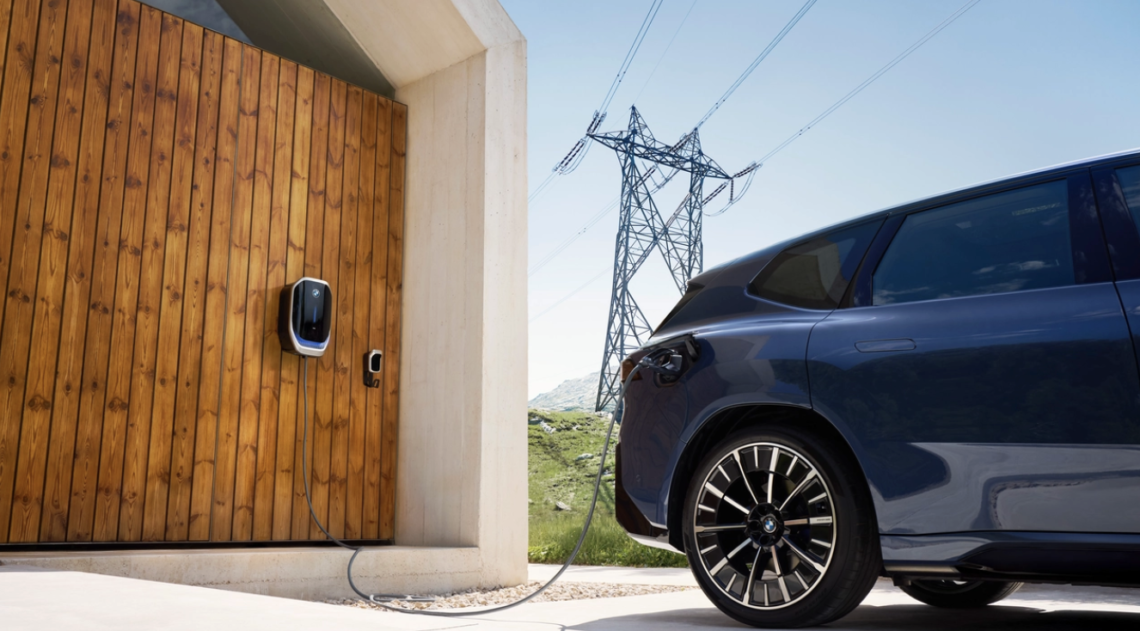

German car maker BMW and E.ON, a Germany-based utility company that serves 47 million European customers, have launched what’s described as the country’s first integrated commercial vehicle-to-grid (V2G) offer. It includes one of the first CCS wall boxes on the market, a compact, wall-mounted electric vehicle charger that uses a Combined Charging System connector to deliver bidirectional power flow, turning the car’s battery into a mobile, dispatchable storage asset.
BMW and E.ON’s joint offer includes a strong incentive for consumers: sending power to the grid could cover the electricity cost of driving 12,000–14,000 km — meaning a parked, grid-connected car could offset the total electricity cost of a German car owner’s typical annual driving.
Meanwhile, Australian households added more than 180,000 home batteries in the second half of 2025, and state and national programs now pay them to connect those batteries to software networks that can draw on the stored energy collectively, stabilizing the grid when demand spikes.
Both are examples of how vehicles, buildings, and devices are increasingly able to store power, return it, and help balance supply and demand in real time, turning the electric grid into a network of intelligent nodes that can adjust consumption or send electricity back to the grid in response to system needs. Collectively they represent a vast sort of distributed flexibility that could help absorb surplus renewable energy, reduce peak demand, and support grid stability, Zhao Yang Dong, Chair Professor and Head of Department of Electrical Engineering at City University of Hong Kong and and Director of the JC STEM Lab of Future Energy Systems, said in an interview with The Innovator.
This new era of “everything to the grid” is one of the top 10 emerging technologies named in a June report by the World Economic Forum in collaboration with Frontiers, the open-science publisher, which he co-authored.
“Balancing the grid” means keeping supply and demand matched second by second, and keeping frequency and voltage within a narrow band, so that the system does not destabilize. As wind, solar, electric vehicles, and data centers reshape both sides of that equation, balancing has moved from a background utility function to one of the defining challenges of the energy transition.
Grid operators increasingly describe flexibility, not generation capacity alone, as the binding constraint on the energy transition. Analysts tracking 2026 energy trends point to the need to balance intermittent renewables, manage surging demand, and maintain grid resilience as a central and growing theme, driven in large part by the rapid, concentrated, always-on load growth from AI data centers.
Get it wrong, and clean-energy targets slip further out of reach even as renewable capacity grows, blackouts and price volatility erode public trust and safety, and utilities absorb rising costs and reputational risk. Get it right, and flexibility, storage, and smarter grid software become the mechanism that finally lets abundant, cheap renewable generation reach homes, hospitals, and factories reliably, turning grid balancing from a hidden technical function into one of the defining commercial and policy opportunities of the energy transition.
But reimagining the grid is easier said than done. The primary obstacles to scale are regulatory and structural, rather than technical.
Take the case of Germany. Germany’s V2G market has long been held back by regulatory hurdles. One key issue was the treatment of electricity temporarily stored in an electric vehicle and later supplied back to the power grid. This buffered electricity was subject to repeated network charges when subsequently drawn from the grid again, creating a cost burden that reduced the economic attractiveness of bidirectional charging. Amendments to Germany’s Energy Industry Act (EnWG) adopted in late 2025 have improved this outlook by easing regulatory barriers associated with electricity storage and re-use.
While further regulatory work on metering and settlement arrangements is still ongoing, BMW and E.ON launched their service. The annual V2G connection bonus of up to €720 represents the maximum amount customers can receive per year and would cover the electricity cost of year-round driving. Customers earn €0.24 for every hour their vehicle is connected in V2G mode, up to a maximum of €60 per month based on 250 connected hours, according to E.ON. And customers receive compensation of €0.42 for every kilowatt-hour fed back into the grid.
State of Play
BMW and E.ON’s offer is one of the most advanced. Other deployments include national pilots, utility programs, and limited commercial consumer offers:
Germany: Volkswagen and its energy arm Elli plan a fully integrated V2G package for private customers from Q4 2026 — vehicle, app, tariff, smart meter, and bidirectional charger bundled together, with owners able to earn an estimated €700–€900 a year. The company says its entire ID. family has been “bidi-ready” since 2023, and pre-registration opened in June 2026, with expansion to other European markets planned.
United Kingdom: Nissan, which has run roughly 40 V2G pilots globally over the past decade, became the first automaker to secure UK G99 grid-code certification for an AC-based V2G solution, following a year-long trial at the University of Nottingham, and plans to bring affordable bidirectional charging to selected EVs in 2026.
United States: Maryland adopted the country’s first comprehensive V2G interconnection rules in June 2025; Sunrun and Baltimore Gas & Electric subsequently launched a vehicle-to-home aggregation pilot using Ford F-150 Lightning trucks, described as the first residential V2G pilot in the US. California and Texas utilities also run live compensation programs for EV owners providing grid services.
South Korea: Hyundai Motor Group is leading an AC V2G pilot aligned with a grid-code update proposed by state utility KEPCO.
The nascent V2G market has huge potential, Markus Grote, PhD, Head of Consumer Retail Innovation at E.ON Group Innovation, said in an interview with The Innovator. “It is a smart way to keep the energy transition affordable,” he says. “The assets are already there, we just need to use them in a smarter way. Look at Germany. At the beginning of 2025, there were around 225,000 electric cars ready for bidirectional charging. Theoretically, these car batteries could supply 2.5 million households for 12 hours overnight. And that potential is likely considerably larger today. This means it can help reduce the need for new conventional generation capacity and make better use of what we have.”
But Grote points out that to unlock the full potential of bidirectional charging, the car, the wallbox, and the grid operators all need to speak the same language. “This can only happen if they are technologically neutral,” he says. “For full scalability we need a certain level of interoperability that allows to create one ecosystem.”
Factors Holding The Market Back
Industry observers say recurring barriers include:
Fragmented standards and connectors. ISO 15118-20, the standard specifying CCS2 bidirectional communication, was only published in 2022 and remains inconsistently implemented; fewer than 15 CCS2 bidirectional charger models were commercially available worldwide as of early 2026.
Inconsistent interconnection rules. Unlike the EU, where ISO 15118 and CCS are coordinated and mandated at the regional level, the United States has no nationwide mandate on connectors or bidirectional protocols; federal requirements under the NEVI program apply only to federally funded charging sites. The result is a jurisdictional “Wild West” of state rules and utility-specific interconnection procedures that raises costs and slows project approval.
Lack of coordination among carmakers, utilities, and regulators. A March 2026 North Carolina State University study identified this absence of coordination — rather than any single technology gap — as the central impediment to scaling V2G beyond pilots.
Proprietary, manufacturer-specific systems. Where charging systems are not interoperable, it becomes harder to aggregate vehicles from different OEMs into the large virtual power plants that give V2G its grid-scale relevance.
Slow recognition of aggregators as market participants, and unresolved questions of taxation, liability, and battery-warranty risk from cycling — non-technical barriers that are recurring points of user and industry hesitation.
Taken together, these point to a market where the core technology is proven and the commercial upside is increasingly quantified, but where scale depends on standards convergence, uniform interconnection rules, and clearer aggregator business models — factors within the control of regulators and industry consortia more than of any single carmaker or charging-hardware supplier.
“Vehicle-to-Grid delivers the greatest value to society when deployed at scale, which is why we are generally open to collaborations,” E.ON said in a statement. “From our perspective, broad adoption of V2G will depend on it becoming an industry standard. E.ON therefore advocates for bidirectional charging and Vehicle-to-Grid solutions that work independently of any specific vehicle manufacturer.”
Why Now?
V2G and other new forms of energy storage and exchange are possible thanks to a generation of new battery chemistries capable of addressing the constraints that have held grid-scale storage back, according to the Forum report. For two decades, lithium-ion batteries have depended on cobalt and nickel, metals concentrated in a handful of countries and subject to price volatility and ethical controversy. Newer chemistries break that dependence by drawing on readily available materials, such as lithium and sodium. While lithium-ion batteries have been the dominant battery energy storage technology, and they continue to evolve with larger-format cells and improvements in balance-of-system and safety, other technologies, such as flow, sodium-ion, and iron-based batteries, are also maturing quickly, says Dong, a co-author of the Forum report. Some of them can charge faster, some can last longer, and most cost less.
The hardware that moves power between these batteries and the grid is also rapidly evolving, with new semiconductors preserving almost all of the energy during round trips and new control systems letting distributed storage actively stabilize the grid rather than passively feed it, according to the Forum report. Coordination software stitches millions of these assets into a single orchestrated resource, and compensation frameworks are beginning to pay for storage based on the flexibility it delivers rather than only for the energy it delivers What these advances produce together “is a layer of distributed storage and intelligence woven throughout the system — coordinated rather than commanded,” says the report.
The technology is here. Regulation needs to catch up. Modernizing safety codes and standards inevitably lags behind design changes and emerging battery chemistries and their integrated solutions. And communities and local officials responsible for project approvals may have limited access to objective technical information needed to evaluate proposals. The fragmented way projects are planned, developed, built, operated, and maintained is also problematic. The team that initially plans an energy storage project rarely procures the equipment, secures the necessary permits, or handles the operations and maintenance after commissioning. Developers, utilities, regulators, and communities often have distinct and differing assumptions about how a project should move forward and the value it should create.
In the U.S., at least 150 local governments across 17 US states have enacted moratoriums, bans, or restrictive ordinances targeting battery energy storage systems (BESS), according to the first publicly available nationwide database of such restrictions compiled by Carina Energy, a Delaware-based firm specializing in battery storage project development. New York leads the country with 98 moratoriums — 65% of the national total — concentrated in the Hudson Valley, Capital Region, and Long Island. States including Indiana, Michigan, Iowa, and Maine are seeing a rising wave of new restrictions as utility-scale battery projects expand beyond traditional renewable energy markets.
The Home Battery Boom
Still, V2G is poised to take off, and homeowners in Europe, as well as in Australia, are already changing how they interact with energy — using dynamic energy prices and home battery automation to cut bills.
E.ON has invested in the Australian tech platform Amber, which makes that country’s largest residential solar and battery automation product with more than 50% of the growing domestic market. Its technology, which is also being used in the UK and parts of Europe, optimizes homeowners’ solar and battery assets by using, storing, or selling energy at the smartest times.
In the UK, Amber’s technology reaches consumers wrapped inside E.ON’s or Ecotricity’s own branded tariffs — not as a standalone Amber retail product like in Australia.
Meanwhile, in June, Octopus Energy announced Nook, its first in-house hardware battery range, at its Energy Tech Summit: Nook Cube, a 2kWh plug-in battery for renters and apartment dwellers that plugs into a normal wall socket, requires no installation, and is expandable to 10.5kWh by daisy-chaining units; and Nook Colossus, a 5kWh wall-mounted, engineer-installed system for homeowners, stackable to 30kWh. Both are solar-compatible, carry a 12-year warranty, and are designed to pair with Octopus’s dynamic tariffs (Agile, Intelligent Octopus) so the battery charges automatically during cheap or negative-price windows. Rollout is planned first in the UK in 2027, then in Germany, France, Italy, and Spain — the same five markets where Octopus already runs retail operations (Octopus entered Italy in 2022 and now has over 900,000 accounts there).
Both Amber and Octopus Energy have a very clear goal: extracting value from wholesale price volatility via home batteries.
E.ON’s partnership wth Amber will help change consumers’ perspectives about energy companies, says. Lioudmila Simon, PhD, Vice President of Innovation Development at E.ON Group Innovation. Instead of being seen primarily as energy suppliers, utilities will increasingly be valued as partners that help them optimize their assets and manage energy costs, she says.
The Changing Role of Utilities
For utilities and other institutions built around the traditional grid, this represents a major change. Some utilities may need to move from selling power to managing networks of distributed assets, says the Forum report. In that model, competitive advantage would depend on coordinating flexibility at scale, rather than owning generation.
“Our mission is to manage these devices at scale, create value for the customer, and unlock flexibility,” says E.ON’s Simon. Leveraging the assets of industrial customers, whether fleets or factories, will also play a major role in balancing the grid and energy markets going forward, she says.
As buildings, vehicles, and factories become active parts of the power system, energy planning will no longer sit only with utilities or energy ministries, predicts the Dubai Future Foundation in the Forum’s report.
For businesses and governments, decisions about fleets, buildings, data centers, and procurement will increasingly shape energy costs, resilience, and exposure to risk. As electrification accelerates, competitive advantage may depend not only on access to power, but on the ability to manage when and where it is generated, stored, and used.This will change how organizations think about their assets, says the report. A delivery fleet, commercial building, or factory could provide grid flexibility by storing power, reducing demand, or releasing electricity back into the system when needed.
Electrification would therefore become less of a standalone infrastructure investment and more of a system-wide planning challenge. This would require grids to become more flexible and decentralized, while regulation would need to move beyond old industry categories. Energy policy will be important, but so will transport procurement, building codes, data infrastructure, software standards, and workforce planning. Together, these choices will determine whether energy becomes a more flexible, connected system or remains constrained by sector-by-sector decisions.
What ties the BMW wall box in a German driveway to a plug-in battery in a London flat is the same underlying shift: The gird is no longer a one-way pipe from a handful of power plants to millions of passive customers. It is become a two-way market in which cars, homes and factors are paid to help keep the lights on. The technology to do this now exists and is maturing quickly., What is missing, as the patchwork of U.S., European and Asia pilots make clear, is the coordination- standards, tariffs, and rules – to let it scale. For utilities like E.ON, that is issue is being reframed as an opportunity: the companies that figure out how to orchestrate millions of small, distributed batteries to provide flexibility to the energy system may end up with more durable customer relationships than those that simply generate and sell power. For regulators it is a test of whether rule making can move as fast as the hardware. And for consumers, it is a simple, tangible proposition – plug in and get paid. That may do more to build public buy-in for the energy transition than any policy speech.
This article is content that would normally only be available to subscribers. Become a subscriber to see what you have been missing