
Crowds began forming before dawn at Lidl stores in France on July 2 when the discount retailer announced a sale on air conditioners and fans as temperatures reached 44°C in parts of the country. A glass entrance door collapsed under crowd pressure at a Lidl in Nanterre as more than 100 people pushed to get in, and video captured physical altercations at multiple locations. Police were called to intervene.
There was a good reason why tempers were running hot: This summer was a scorcher. 2026 is poised to be either the warmest or second-warmest year since instrumental records began in the mid-1800s, in a virtual tie with 2023, 2024, and 2025 — the four hottest years ever measured. Western Europe was hit by a rolling sequence of heat waves beginning in late May — the region’s fourth of the year by late July — with temperatures repeatedly topping 40°C (104°F) across France, Spain, Germany, Portugal, and the UK. Close to half of French homes — 48.2% — have “insufficient” cooling, resembling a thermal cauldron during the increasingly frequent heatwaves that scientists say are linked to human-induced climate change, according to a June 19 analysis by consulting firm Pouget Consultants, commissioned by IGNES (the French alliance of building electrical and digital equipment manufacturers).
The problem is even worse in less-developed economies. Currently, around 3.5 billion people live in climates defined as “hot.” Only 15% benefit from air conditioning while even ‘passive’ low-tech solutions such as insulation or design that incorporates more efficient orientation or shading are out of reach for poorer groups, according to a UNEP report.
Heat-related deaths are already running at an annual average close to 500,000 while the rate among people over 65 is projected to increase almost four-fold by 2050 from around 300,000 per year in 2018, according to the UNEP report. At the same time, poor access to refrigeration makes it difficult to store perishable vaccines, resulting in thousands of preventable deaths from disease—particularly among children—while about one third of food produced is lost.
Zero energy cooling technologies – one of the top 10 emerging technologies named in a June report by the World Economic Forum in collaboration with Frontiers, the open-science publisher, could help save lives and abate the heat
Passive radiative cooling technologies – which build on everything from a technique used to make ice in the desert 3,000 years ago to the reflective heat-radiating hair structure of the Saharan silver ant – are already starting to be commercialized. They include self-cooling paints, films, and materials to improve roofing, refrigeration, and building materials. Use cases include apartment towers in Hong Kong’s poorest district, electricity-free cooling marine coatings for the shipping industry, and cold storage facilities and warehouses in the U.S.
Two of the world’s largest building markets have written passive radiative cooling into law, according to the Forum report. California’s Energy Code requires cool roof materials on most commercial and high-rise buildings, and China’s Dual Carbon policy has incorporated the technology into national green building standards, notes the Forum report. The embrace by these regulators has brought chemical giants, including Arkema and Solvay, into the supply chain and helped manufacturing shift from complex laboratory processes to standard industrial coating and film production, the report says.
“We believe passive radiative cooling will make a tremendous impact on the increasing need for affordable and accessible cooling solutions to mitigate the increasing intensity of global heat waves,” says Anish Thukral, a research scientist and materials engineer at SRI, a California-based independent nonprofit research institute, which has developed a self-cooling paint. SRI’s paint was named a 2025 BloombergNEF (BNEF) Pioneers competition finalist. The competition celebrates leading innovations with the potential to play an important role on the path to a net-zero economy.
How Passive Radiative Cooling Technology Works
Although the atmosphere traps most infrared radiation, it allows a narrow range of infrared wavelengths to pass through into deep space. Passive radiative cooling materials are designed to release heat within that same range, allowing surfaces to cool without using electricity, explains the Forum report. They also scatter over 95% of incoming sunlight before it becomes heat, using microscopic air bubbles that act as mirrors at the scale of a wavelength of light. A surface doing both loses more energy than it gains and drops below the temperature of the surrounding air, without consuming any power. These properties can be embedded into paint, roofing materials and heavy-duty fabrics, applied to new construction or retrofitted onto existing structures.
“Radiative cooling has been around for thousands of years,” says SRI’s Thukral, “Our ancestors were using it to make ice and cool things at night. The concept is the same. Why not use the cold of space as a heat sink during the day? By combining high solar reflective technology with the radiative cooling technology, we can get daytime cooling.”
SRI did just that to create self-cooling paint. SRI’s first licensee Cryo X, along with its most recent licensee, Pioneer, are commercializing the paint and both have demonstrated scalability by using OEM manufacturers to make SRI’s paint in their regular facilities. “The supply chain is quite robust and established,” Thukral says. “The impact has been notable.”
In its labs, SRI tested the temperature differences between self-cooling painted aluminum plates versus regular white paint. “The temperature differentials are crazy: close to 10 degrees Celsius in an afternoon where you have maximum heat and solar exposure,” he says. “Compared to a non-painted aluminum substrate, there is a 20 to 25 degrees Celsius differential just by painting it with self-cooling paint. That’s the case for a four-inch by four-inch metal substrate. Now imagine you have a whole rooftop that is a metallic sheet and how much heat that can create inside the structure. Freight storage containers are made of metal, and people who need to load and unload those containers faint from the heat. If you can apply self-cooling paint, you might not need air conditioners.”
Why Today’s Cooling Solutions Aren’t Sustainable
The same heat waves driving record demand for cooling are being intensified, in part, by the cooling systems people rely on to survive them.
On a sunny afternoon in a dense city neighborhood, heat settles into the concrete underfoot and the asphalt beyond it, explains the Forum report. The street’s geometry slows the wind that might help carry this heat away, and the air conditioning units running in every building push more heat outside, where it accumulates. U.S. urban heat islands are now, on average, 0.5–4.0°C warmer than surrounding rural areas during the day.
But demand for new cooling technologies is not just being driven by the need to beat the heat. The electricity that runs air conditioners is still substantially fossil-fuel-generated in most of the world, so cooling demand — which spikes precisely during heat waves — pushes more power plants to burn more fuel at the moments grids are most stressed; researchers modeling the eastern U.S. found regional power-plant emissions rise roughly 3%–4% for every 1°C of added summer heat. Second, the refrigerants inside most AC units — HFCs, and older HCFCs still in use in parts of the world — are themselves potent greenhouse gases when they leak, a growing share of the total footprint as the global fleet of units expands.
The International Energy Agency projects the number of AC units in use could nearly triple by 2050, driven mainly by rising incomes in hot, populous countries such as India and China. Absent stronger efficiency standards, that growth alone could roughly triple annual cooling-related emissions — even as the IEA also estimates that 2 to 4 billion people, mostly in the Global South, currently lack access to any indoor cooling and remain at elevated risk of heat stress. Mobile air conditioning in vehicles adds a further roughly 420 million tonnes of CO2-equivalent a year, a figure the IEA projects could triple by 2050 without policy intervention.
The dilemma researchers and UN agencies point to is not that cooling is optional — access to air conditioning is estimated to cut the risk of heat death by around three-quarters — but that the dominant technology for delivering it currently reinforces the warming that makes it necessary in the first place. That tension is the opening for alternative approaches, including passive radiative cooling, which sheds heat without the electricity draw or refrigerants of conventional AC.
Commercial Offers
Hong Kong’s i2Cool, which says its technology’s design is inspired by the Saharan silver ant, makes iPaint, a passive radiative cooling paint plus films for a range of surfaces. Spun out of City University of Hong Kong’s School of Energy and Environment, the company has raised $13.8 million. i2Cool says its i2Coating product had already been used in more than 200 projects worldwide covering 300,000+ square meters, reducing surface temperatures by up to 42°C and cutting air-conditioning energy costs by 10%–40%.
i2Cool’s most socially prominent application has been applying its white iPaint to the rooftops of some of Hong Kong’s oldest and hottest housing stock — the subdivided flats of Sham Shui Po, one of the city’s poorest districts, where top-floor units have been measured at over 40°C during summer heatwaves. The company says that residents of a 50-year-old Sham Shui Po building saw indoor temperatures drop 3 to 8°C after the white iPaint was applied to the roof, with electricity bills falling by about 40% and the shielding effect still measurable after one year.
i2Cool co-founder Prof. Martin Zhu has publicly framed this strand of the business explicitly as a social mission rather than a pure commercial play, stating the company aims to make cooling “affordable and accessible for all” rather than limited to premium commercial customers, while still scaling internationally.
In March of last year i2Cool announced a global strategic partnership with Marubeni, one of Japan’s largest general trading houses. The stated focus is twofold: expanding i2Cool’s technology into the Japanese market, and jointly developing electricity-free cooling marine coatings for the shipping industry — coatings intended to improve solar reflection and infrared radiation on ship hulls and superstructures, reducing cabin temperatures and onboard air-conditioning energy use.
The technology emerged from a development project Osaka Gas began in 2017; the company was spun out in 2021 to commercialize and sell the material. Osaka Gas remains a co-owner alongside venture capital firm WiL, giving the venture a large industrial parent with construction, energy, and materials relationships across Japan.
SPACECOOL’s deployments to date include the Gas Pavilion at Expo 2025 Osaka, Kansai – one of 13 corporate pavilions at the exposition, sponsored by the Japan Gas Association – which was clad in a silver membrane made from SPACECOOL material.
SPACECOOL says other implementations are now advancing in Japan, Thailand, Saudi Arabia and the UAE. It says its technology can reduce indoor temperature by up to 10°C and cut cooling energy by 30–40%. The company won Japan’s Energy Conservation Grand Prize in 2025 and a EURAMET-led European metrology consortium (the PaRaMetriC project) is collaborating with SPACECOOL to help standardize how passive radiative cooling materials are characterized and compared — a sign the material is being treated as a reference-grade product by European standards bodies.
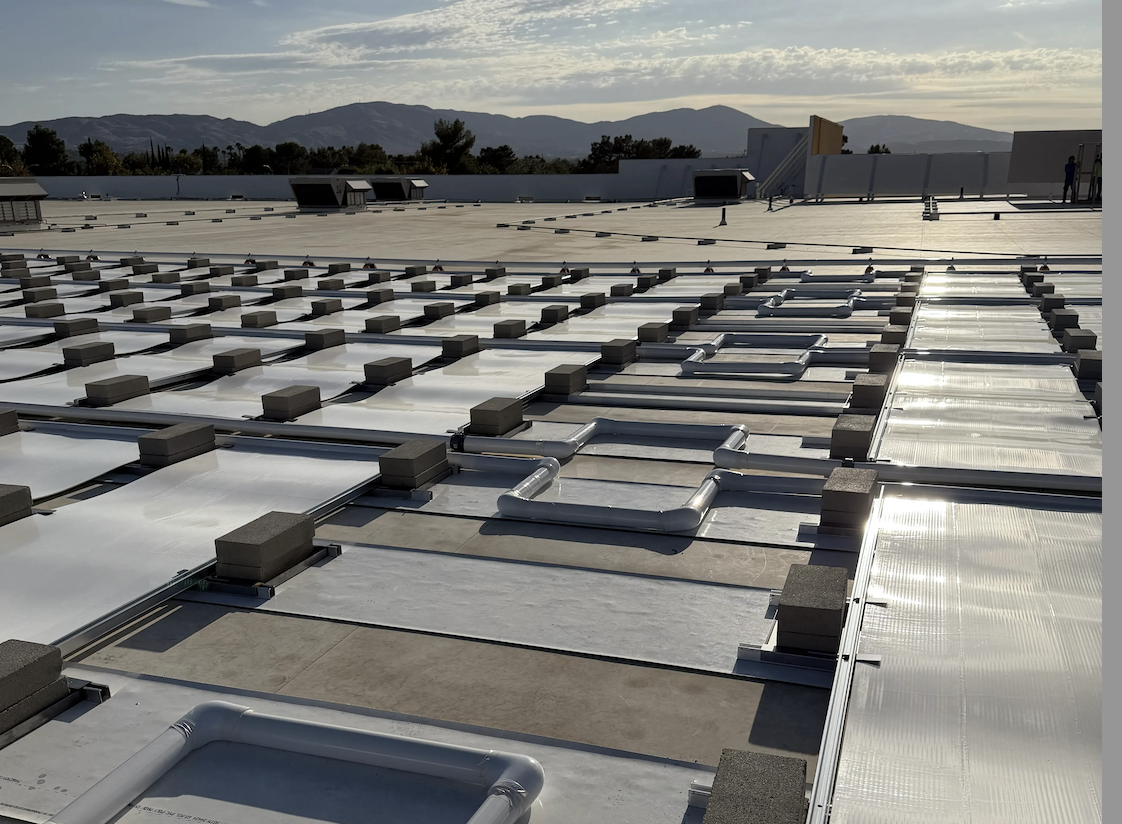
Meanwhile, California-based SkyCool, a finalist in the 2026 BloombergNEF Pioneers Challenge, is using the technology to build resilient cooling infrastructure that can be used to avoid growing HVAC adoption, and offer industrial customers more durable and modular heat rejection that uses very little electricity, no water and is nearly silent. An industry pioneer, it was the first team to demonstrate how passive radiative cooling can work, publishing a paper in Nature in 2014 that the company says has become among the most cited in the field of physics. “We are really focused on turning basic physics into practical cooling infrastructure,” Arjun Saroya, CEO of SkyCool, said in an interview with The Innovator. For example, rather than offering to cover a roof with paint or film it has developed integrated roofing material (see the photo) that can either be retrofitted or installed as a new roof in new buildings.
Warehouses are a big focus. “We are not really trying to replace roofing, we augment existing buildings,” says Saroya. In the past many warehouses were comfortable to work in most of the year, he says, but with today’s extreme heat owners are having to retrofit buildings with air conditioning. “It is very expensive – $10 a square foot and another $5 for the operating cost,” says Saroya. “We can comparatively cool the warehouse for $3 to $5 a square foot and almost no operating expense except an occasional cleaning,” he says. The cool roof surface that SkyCool installs has a dramatic impact inside, he says, lowering the air temperature by 10 to 15 degrees Fahrenheit at peak outdoor temperatures and can be even greater during other parts of the day. “That can help avoid having to shut down a line on a very hot day, and in places like Phoenix, Arizona, where temperatures reach 105°F to 115°F, it can mean the difference between life and death.”
Target, the retail chain, began testing SkyCool panels used for refrigeration in 2021 and has publicly said that it has since installed more than 600 across 21 stores. The panels are used for subcooling and desuperheating (the process of removing excess heat from superheated vapor or steam to lower its temperature closer to its saturation point). Subcooling reduces flash-gas formation and improves the system’s coefficient of performance while desuperheating stabilizes operation on the hottest days by lowering refrigerant discharge temperature and compressor workload. The reason this matters is because most refrigeration systems in operation today were not designed for the temperatures they are experiencing, says Saroya. “This is leading to premature asset failure and large capital expense,” he says. “SkyCool is offering modular and scalable heat rejection that allows mission critical systems to adapt to extreme heat.
Data centers can also benefit from radiative passive cooling, says Saroya. They generate intense internal heat, overwhelming cooling towers and other traditional ways of bringing down the temperature. As a result, an academic study found that temperatures a half a mile outside of the data centers are 2 to 4 degrees Celsius higher than surrounding areas. SkyCool’s cold surface roof technology makes the temperature more manageable for the equipment and helps cool the neighboring area without the need for water, he says.
Outlook
If people around the world are suffering from extreme heat and passive radiative materials are getting the good results that the companies developing them claim why aren’t more buildings using them?
“The challenge is industrialization,” says SkyCool’s Saroya. “There are four things that need to happen: standardization of performance measurements; long term durability that fits warranty structures for buildings needs to be demonstrated; building codes and utilities procurement need to incorporate the technology and the technology needs to scale so that costs will come down.”
To become standard practice, passive radiative cooling materials still need to prove long-term performance under sustained UV exposure, dust and humidity, says the Forum report. Standardized testing protocols, warranty frameworks, and building simulation tools would help give developers, certifiers, and public authorities confidence. Building codes in most jurisdictions do not yet account for passive radiative cooling, limiting its use for regulatory compliance. Integration into rating systems such as LEED and BREEAM would help move the technology towards standard practice.
Whether passive radiative cooling becomes standard will depend on how quickly regulation and standards move, says the report. Without that support, it may remain a specialized upgrade as cooling demand and operating costs rise. If the latter is the case, episodes like the frenzied fight for air conditioners and fans at Lidl in France could become more commonplace around the world.
This story was reported and written by the author. AI was used to help with research. Results were verified by the author. AI was also used to copy edit the story.