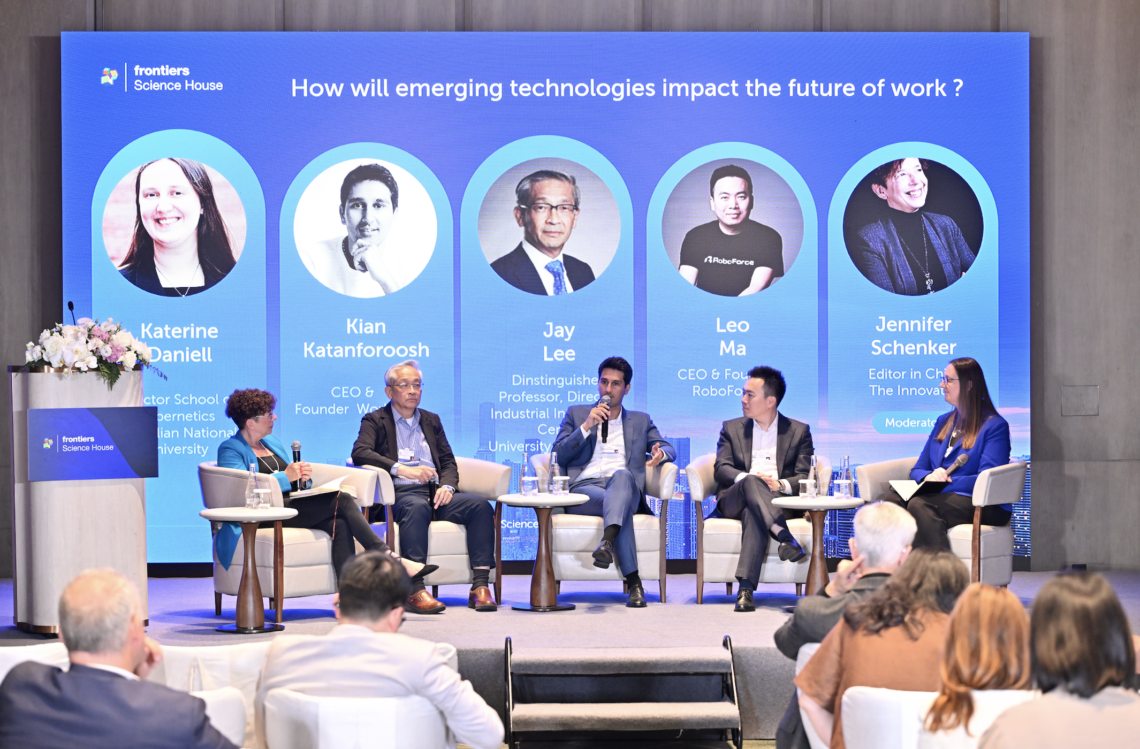

The conversation around emerging technology tends to focus on a race: which country will build the first fault-tolerant quantum computer, which will dominate humanoid robotics, which will control the supply chains for tomorrow’s batteries and chips. A harder question gets less airtime — not who gets there first, but how these technologies get diffused widely and equitably enough to move the needle for people and the planet. That topic ran through a Frontiers Science House Roadshow event, held as a side event during the World Economic Forum’s Annual Meeting of the New Champions in Dalian, China, June 23–25.
The Dalian event coincided with the launch of the Top 10 Emerging Technologies of 2026 report, compiled by the Forum in collaboration with Frontiers, and was part of a roadshow to promote Science House, a gathering place on the promenade in Davos organized by Frontiers and dedicated to the transformative science required to address societal challenges. (The Innovator is a media partner of Science House.)
The roadshow kicked off with an introduction by Frontiers Chief Executive Editor Frederick Fenter and a keynote from Abdulaziz AlJaziri, Deputy Chief Executive Officer of the Dubai Future Foundation and a contributor to the Top 10 report. These talks were followed by two panels moderated by Jennifer L. Schenker, founder and Editor-in-Chief of The Innovator, on the future of work and on climate and sustainability, The race-versus-diffusion tension surfaced in both: panelists debated which nations are best positioned to win as often as they debated whether governance, data access, and capital are keeping pace with the science.
The event made clear that the world needs technology and science more than ever. AlJaziri set the scene with assumptions the Dubai Future Foundation treats as near-certain: climate change will persist, potentially doubling the number of people in extreme poverty by 2050; longer lifespans will outpace healthcare systems; inequality will continue to widen; technology costs and investment will keep climbing; and global economic interdependence will keep deepening regardless of geopolitical shocks.
The ten emerging technologies could help mitigate those predictions. They include: everything-to-grid energy (buildings, vehicles, and devices become a place that can store power, return it, and help balance supply and demand in real time, turning the grid into a network of intelligent nodes); passive radiative cooling materials; precision fermentation; personalized mRNA cancer vaccines; exosome drug delivery (using the body’s own couriers to deliver medicine); direct lithium extraction; forever chemicals (PFAS) destruction; world models (AI that can think and act in three dimensions); and lattice-based cryptography, which protects today’s data against tomorrow’s computers.
Some of these technologies are becoming more distributed, producing food, energy, and critical materials closer to where they are needed, says the report. And some do more with less, producing cooling without power, protein without herds, and chemistry without persistent waste.
These technologies are approaching the moment when decisions made now by governments, industry, and researchers will determine how they arrive in the world, the report notes.
The event’s two panels examined how other emerging technologies — such as AI and robotics — are already starting to impact people and the planet, and whether business and policymakers are keeping up with the science and technology.
Emerging Technologies and the Future of Work
The panel on emerging technologies and the future of work included Katherine Daniell, director of the School of Cybernetics at Australian National University; Leo Ma, founder and CEO of RoboForce, a Silicon Valley humanoid- and industrial-robotics startup; Kian Katanforoosh, co-founder and CEO of Workera and a Stanford adjunct lecturer who co-created the widely used deep learning specialization; and Jay Lee, director of the Industrial AI Center at the University of Maryland.
Key points:
- Boards are anxious, not ready. Daniell said executives across sectors are largely fearful and searching for trusted advisers who can demystify AI and show them real examples of what has worked and failed elsewhere.
- AI now touches the entire employee lifecycle — hiring, onboarding, coaching, performance management, succession planning — with Katanforoosh calling AI-driven coaching one of the most promising near-term applications.
- Productivity isn’t the same as competitiveness. Lee noted that many manufacturers using AI have become more efficient without fundamentally repositioning themselves competitively; the more durable gains come from using AI to open new revenue streams and rethink the business, not just cut costs.
- Industrial AI needs real-world data, not generic datasets. Lee argued that training competitive engineers and models requires proprietary, sector-specific data — from semiconductor yield data to fleet and turbine data — rather than open-source or scraped datasets.
- Robots are seen as augmenting labor, not replacing it. Ma said RoboForce’s ambition is to take on physically demanding jobs humans are capable of doing but are unwilling to do, rather than to displace workers broadly.
- AI may be a fairer judge than humans in hiring, Katanforoosh argued, because algorithmic bias can be audited and corrected, unlike human bias — though he expects human judgment to remain central to establishing trust and rapport later in the hiring process.
- Systems need backups. Daniell warned that overreliance on AI systems without redundancy is risky, citing her experience with outages and disruptions in Australia.
- Adoption metrics can mislead boards. Katanforoosh said high usage statistics often mask whether employees are using AI superficially (e.g., rephrasing emails) or transformatively (e.g., building sub-agents); measuring actual skills and outcomes, not just adoption, is the next frontier for workforce planning.
- On regional competitiveness, panelists were split: Ma described a “triangle” of advanced models, advanced manufacturing capacity, and accumulated domain data as the real sources of long-term advantage; Daniell said leadership will vary by sector, citing China’s edge in industrial manufacturing and renewables versus opportunities for Australia and Canada in agriculture and mining.
- On the one skill to teach the next generation, the panel offered resilience and adaptability (or “durable learning”), character and taste, and imagination paired with the ability to make things.
- Pros and cons: Daniell said the future of work still lacks sufficient human and environmental connection amid the rush toward efficiency; Lee pointed to a coming “non-deterministic, compounding” world that most institutions are not prepared to navigate; Katanforoosh argued AI could help build a more meritocratic workforce if deployed well.
- Governance is lagging, especially on data and privacy. Daniell pointed to gaps around informal, ungoverned AI use inside organizations and schools, and urged leaders to prioritize internal policy and testing before external rollout.
The Impact of Emerging Technologies on Climate and Sustainability
The impact of emerging technologies on climate and sustainability panel included Himanshu Gupta, CEO and co-founder of ClimateAI, who previously helped draft India’s renewable energy chapter for its national five-year plan and worked on emissions modeling for India’s Paris climate talks; Vanessa Chan, inaugural vice dean of innovation and entrepreneurship at Penn Engineering and former U.S. Department of Energy chief commercialization officer; and Jason Bordoff, founding director of Columbia University’s Center on Global Energy Policy and former senior director for energy and climate on President Obama’s National Security Council staff.
Key points:
- Distribution of impact matters as much as invention. Gupta pointed to India’s push to build an AI-and-financial “stack” for farmers — enabling low-cost, localized crop and pest guidance via WhatsApp and radio — as the biggest near-term opportunity for scaling climate-relevant AI.
- Grid flexibility: Chan highlighted distributed energy resources and virtual power plants — including bidirectional EV charging and data centers as flexible grid assets — as underused, already-proven technology.
- Corporate climate action is often driven by procurement, not sustainability. Gupta said companies like PepsiCo adopt climate-resilience tools mainly to protect supply-chain reliability and budgets, not for ESG reporting.
- The real bottleneck for commercializing clean technologies is unit economics, not policy alone, Chan said, drawing on her work leading the DOE’s “pathways to commercial liftoff” reports. Her framing: private-sector-led, government-enabled, with policy as a catalyst rather than a permanent crutch.
- Bordoff pushed back on an affordability-only view, arguing that without policy to price in the negative externalities of emissions, fossil fuels — remarkably versatile and deeply embedded — will keep finding new uses even as clean alternatives get cheaper.
- Geopolitics and supply-chain dependence on China dominated the policy discussion. Bordoff argued the U.S. and allies need a more precise, differentiated conversation about which import dependencies (oil, solar panels, rare earths) pose which kinds of security risk, rather than treating them as interchangeable.
- China’s long-term industrial strategy versus short political and corporate cycles was raised as a structural disadvantage for the U.S. and Europe: Chan noted that average CEO tenures and election cycles discourage the kind of sustained, unprofitable-at-first investment China has made in scaling clean technology.
- AI’s energy tension is real but manageable, panelists argued. Gupta said climate-specific AI models can be smaller and more efficient once purpose-built, reducing compute needs over time. Chan pointed to research on task-specific AI models and chip redesign that could cut data center energy use significantly. Bordoff added that AI’s value in accelerating clean energy deployment, grid optimization, and advanced nuclear or fusion research likely outweighs its own energy footprint.
- Hyperscalers are playing an outsized role in clean energy procurement, Chan said, describing a shift from “bring your own battery” to “bring your own clean” as large tech companies pay a premium for clean power to bring down long-term costs.
- Green washing: Better AI-driven forecasting and emissions reporting could create a “sophisticated adaptation without mitigation” trap, where companies get better at measuring and adapting to climate change without actually cutting emissions. Gupta agreed this is a risk but noted AI-enabled verification is also making corporate net-zero pledges harder to fake.
- Top policy priorities: Gupta pointed to data governance and standardization — citing India’s inability to track and reduce its own transmission losses, or even access personal utility data, due to fragmented, non-interoperable data standards.
Accelerating The Diffusion of Emerging Technologies
The importance of diffusing technologies widely enough to matter was not just a focus at the Science House roadshow event. It was front and center at the World Economic Forum’s Annual Meeting of the New Champions Dalian event. This year’s theme was “Innovating at Scale.” In a June 25 press release the Forum noted that despite record investment in AI, quantum computing, and biotechnology, productivity growth across most economies remains sluggish, highlighting a widening gap between technological potential and economic outcomes. “To be truly transformational, the benefits of technological progress must be widely shared and contribute to broad-based, resilient growth,” the release said. “Adoption at scale is needed to turn innovation into tangible progress for industry and people, meaning that the next phase of innovation is as much about accelerating the diffusion of emerging technologies as it is about generating new breakthroughs.”
The Top 10 Technologies report’s own strategic outlooks return to the distribution issue in nearly every chapter:
- On everything-to-grid energy: “As energy becomes more connected across industries, the central question is whether it develops as a shared system of resilience or as a fragmented race to capture control and value,” the report notes.
- On passive radiative cooling materials: whether the technology becomes standard in the hottest regions will depend on how quickly regulation and standards move, the report says; without that support, it may remain a specialized upgrade as cooling demand and operating costs rise.
- On precision fermentation: whether food security shifts from regions that grow protein to regions that can power its production will depend on decisions about capital, intellectual property, and regulation made now.
- On personalized mRNA cancer vaccines and exosome drug delivery: both could lead to major improvements in health, but progress will depend on whether pharmaceutical companies, hospitals, insurers, and governments can turn these breakthroughs into something every patient can access.
Trust in these systems is not a soft variable — it is a precondition that must be deliberately built, Daniell said during the future-of-work panel. Science and technology are racing ahead. Whether policymakers and business can build that trust and diffuse these breakthroughs widely enough to matter and fast enough to keep pace, will depend on getting the right stakeholders around the table. That, says Frontier’s Fenter, is the goal of Science House.
Videos of the Science House roadshow can be accessed by clicking the links below:
-
Welcome from Frontiers Chief Executive Editor Frederik Fenter https://www.youtube.com/watch?v=uCgRcFJSLZk
-
Keynote, Dubai Future Foundation https://www.youtube.com/watch?v=FRYZM0o9byY
- How will emerging technologies impact the future of work? https://www.youtube.com/watch?v=pCVZpFE_AzM
- How will emerging technologies impact energy and climate? https://www.youtube.com/watch?v=gnev_hLWUZQ