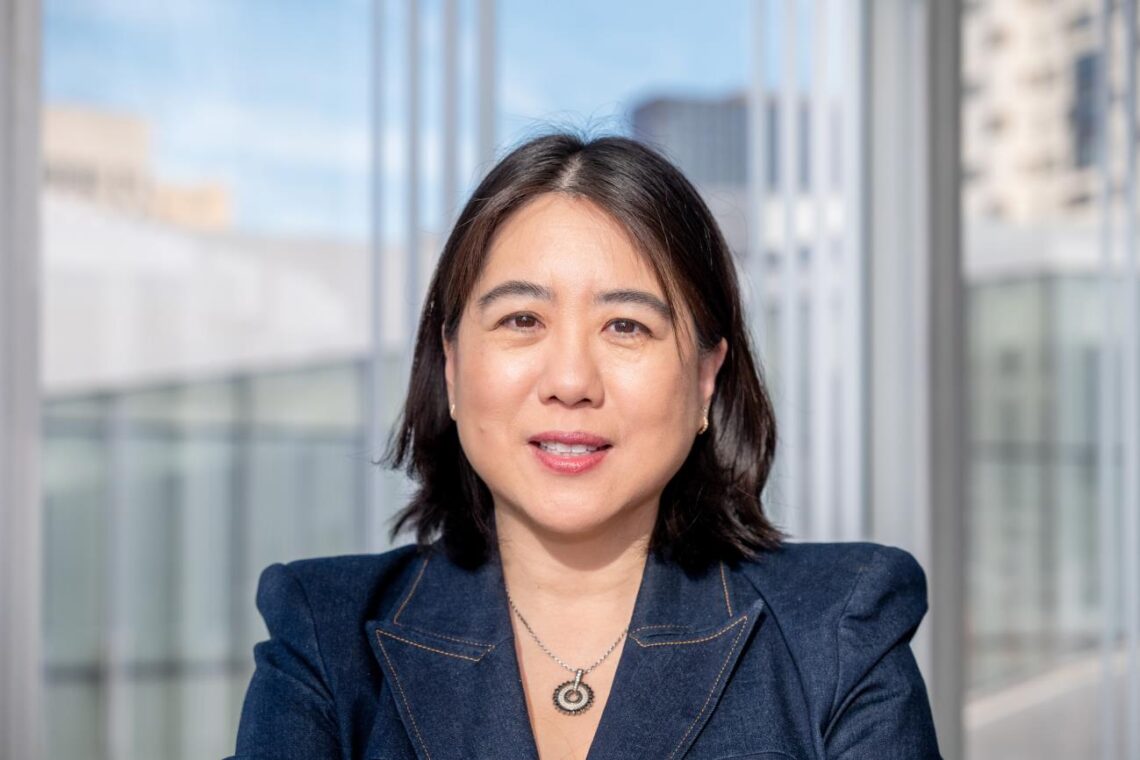

Vanessa Z. Chan is the inaugural Vice Dean of Innovation and Entrepreneurship at Penn Engineering. She previously served as Chief Commercialization Officer and Director of the Office of Technology Transitions at the U.S. Department of Energy (DOE) under the Biden administration. In that role, she was responsible for driving private-sector uptake of clean energy technologies across the DOE, its 17 national laboratories, and all research and production facilities nationwide. She also led the DOE’s “Pathways to Commercial Liftoff” reports, sector-by-sector roadmaps for decarbonizing geothermal, hydrogen, and other critical energy areas and the development of the Adoption Readiness Level (ARL) framework which identifies non-technical barriers (Market demand, policy, supply chains etc) that need to be overcome for a technology to be deployed.
Before these roles, Chan co-led McKinsey & Company’s innovation practice, helping large publicly traded companies commercialize their technologies. She also founded re.design, a consumer products startup. As an entrepreneur, she competed on NBC’s Today Show Next Big Thing and sold her first consumer product invention live on QVC, a U.S. home shopping network where hosts sell products in real time on television.
At Penn, she is transforming corporate partnerships and how engineers are being trained by embedding real-world skills into the curriculum. She has also pioneered a new course where PhDs put their thesis through the ARL framework, cold-call 40 people in industry to understand non-technical risks and write a chapter on how their technology can be commercialized.
Chan earned a Ph.D. from MIT and a B.S.E. from the University of Pennsylvania, both in materials science and engineering. She holds three patents and is the author of multiple scientific papers, including a first-author paper in Science. In 2024, she was named to TIME’s 100 list of the world’s most influential business leaders in climate change. Chan spoke on a panel moderated by The Innovator’s editor-in-chief during a side event organized by Frontiers, the open-science publisher, at the World Economic Forum’s Annual Meeting of the New Champions in Dalian, China, in June. She agreed to a separate interview with The Innovator about the energy transition.
Q: Distributed energy resources and virtual power plants — including bidirectional EV charging and data centers as flexible grid assets — are already proven but underused. What needs to be done to change that?
VZC: Virtual Power Plants (VPPs) aren’t being held back by the technology—they’re being held back by the way we’ve designed electricity markets and utility incentives. Today’s grid was built around large, centralized power plants, while VPPs rely on coordinating millions of distributed resources like batteries, EVs, and smart devices. As regulators modernize market rules and utilities are rewarded for delivering grid services instead of simply building infrastructure, VPPs can become a powerful tool for improving reliability, lowering costs, and meeting rapidly growing electricity demand. The question is no longer whether VPPs work—it’s whether policy and market design can evolve quickly enough to unlock their full potential.
Q: You’ve said the biggest thing holding back frontier energy technologies is unit economics. China seems to have cracked this by using the same playbook repeatedly and building ecosystems that scale. How do we achieve this in the West?
VZC: Daniel Goldman from Clean Energy Ventures and I recently published an op-ed in Latitude Media on why tariffs are not the answer for winning this battle. I think the key thing about China is that they’re willing to invest even when the unit economics don’t make sense yet, because they’re playing a long game, whereas we’re much more short-term-focused as capitalists. Right now, because the unit economics aren’t there for these technologies, we’re not willing to invest, since everyone wants to make money. Meanwhile, China is investing to make the unit economics work — to move down the cost curve and up the learning curve. By the time China gets there it will have built out the supply chain. That’s what happened with solar: we invented it in the U.S., but we weren’t willing to make the investment needed to grow a market and an industry that wouldn’t turn a profit. The timeline for when these investments payoff is well beyond a normal CEO’s, senator’s, or president’s time horizon so to make an investment now, would benefit someone in power many years after they leave. That’s the biggest challenge we have.
One thing we need to figure out is how we, as capitalists, spread risk in a way that lets people take a short-term loss, understanding that the long-term payoff is much bigger. Until we do that, it will be very difficult for us to lead in scaling frontier technologies, because no one is willing to take a loss on the first, second, or third of a kind. The question is how we shift to investing in the first ten of a kind in order to build an ecosystem. To do that, we can’t use the same financial instruments we use today — we need to think about risk very differently. And right now, in the U.S., we’re not doing that.
Q: Given what you have just said, what’s the best chance for developers of frontier energy technologies to scale?
VZC: The ecosystem needs to think about risk differently – for example, can companies accept a lower return on invested capital — investing even when a technology isn’t yet profitable. Frontier energy technology companies can try to partner with larger companies, but those companies are publicly traded and need to grow earnings per share and their stock price. So, when an investment hurts near-term earnings and profitability, it works against shareholders’ short-term interests. We’re capitalists, so until we think differently about risk and return, we have a problem.
Until the U.S. has a capital stack and risk stack built around a different mindset, it will be very hard to scale these technologies. The only way frontier technologies can reach the market is by becoming more affordable than existing energy technologies — and the only way to do that is to manufacture and deliver them at the same cost or cheaper than existing energy sources. That requires scale, but we can’t scale until we start to invest to go up the learning curve and down the cost curve, and right now there is not enough investments to make that happen.. So that’s the core problem: people want to make money from technologies that aren’t there yet, and we don’t have a clear pathway to make these technologies profitable. That’s why we published the op-ed arguing that a major mindset shift is needed.
We need the federal government, companies, and philanthropic organizations to come together and rethink the capital stack and risk stack. If you’re building infrastructure, are you willing to break even — or take a small loss — on the first builds? Are you willing to pay more? I think the hyperscalers are doing a great job here: they’re willing to pay a premium to secure contracts with nuclear power plants and other providers. For a supply chain to get built, you need offtake agreements, but right now people won’t sign offtake agreements until a supply chain exists — it’s a chicken-and-egg problem. Hyperscalers are stepping up, signing offtake agreements before the supply is fully there and paying a premium for the electricity generated. We need more of that kind of thinking.
Q: As part of your job at the DOE, you helped rank the maturity of various technologies. What do you see as the most promising in the near to midterm?
VZC: I don’t rank the technologies, because it’s a bit like having kids — they each have their strengths and weaknesses, and you don’t rank your children because you never know when a weakness might be overcome. So at the DOE, we focused on articulating the risk score — both technical and adoption risk — that had to be overcome for each technology to scale and meet our energy demands. We need everything to work. Every ‘kid’ plays a role; I’m not going to put all my resources on my top two and forget about the other ten.
That said, I think there’s real progress in geothermal — Tim Latimer, the CEO of Fervo, is an incredible leader who’s done remarkable work advancing the technology. I’m also encouraged by the moves the Trump administration is making to continue supporting nuclear. In every scenario we ran, nuclear needs to play a part, so I’m glad there’s bipartisan support for it and that the current administration is taking a leadership role there. Grid-enhancing technologies, as I mentioned, are important too.
One thing we do need to think about is the role of utilities. Too often, as we try to deploy new technologies, utilities want to run their own pilots — so if I pilot something at Utility A and then go to Utility B, they’ll say, ‘No, we’re different, you need to pilot it with us too,’ and we end up with death by pilot. There’s a need for the utility industry to band together and share pilot data, so startups and smaller companies can move faster with new technologies.
I was recently at the Joules Accelerator in Charlotte, North Carolina, [ a founding member of The U.S. National Science Foundation Engine for Grid Modernization in the Carolinas, a transformative federal investment that establishes North and South Carolina as a national hub for modernizing the nation’s electric grid.]. We had good conversations with a group of utilities representing almost two-thirds of the American population about thinking differently about pilots. We need a more transformative approach here.
Q: How do you feel about where we are in the energy transition? Are you frustrated that we haven’t gone further? What more would you like to see happen?
VZC: There have been mistakes made along the way. For me, it comes back to unit economics — the frustration is that we’re not willing to move faster because everyone is focused on making money. I also think mistakes were made under the Biden administration in rolling out 45V [the Inflation Reduction Act (IRA) 45V clean energy tax credit rules for the production of clean hydrogen]. We spent over a year figuring out how to implement that policy, which cost us a year in getting hydrogen hubs off the ground — and now that’s no longer a possibility.
So, I think we need longer-term thinking in the U.S., and more bipartisan continuity between administrations. I’m a moderate, and it makes me sad to see how polarized our country is right now — if one administration does something, the next one won’t acknowledge or build on it, and that’s not good for the American people. I wish there were a way to think longer-term across administrations and with the corporate sector. We’re just too short-term in our thinking.
Q: As an academic, what do you hope to achieve with your students? How are you trying to inspire them to help move the energy transition forward?
VZC: My entire career has focused on technology commercialization, and the biggest challenge is that we don’t teach engineers anything about the real world in traditional universities. We train them to be technically deep, but we don’t teach them how the energy industry works, or the pharmaceutical industry, for that matter. We also don’t explicitly teach real-world skills — how to cold-call, how to talk succinctly and coherently about their work rather than focusing only on the technology, and how to understand the real-world problem behind it.
My focus now is transforming engineering education so we’re not just producing students who are technically deep, but who also have real-world skills and an understanding of industry. Imagine engineers coming out of Penn Engineering who are technically strong and also equipped with those skills. For example, I piloted two courses last year. In one, an intro to materials science and engineering course, students couldn’t leave the classroom until they’d said something in class and received a tennis ball — and once they had one, they couldn’t speak again until everyone else had a ball too. The students who talk too much learn to hold back, and those afraid to speak are forced to — which is nerve-wracking for people who got through high school without ever having to speak up.
In that same course, I put students in teams and sent them on a scavenger hunt around Penn’s campus to find problems that materials science could solve. They had to take pictures, choose one, and identify the problem: why did the material fail, how big is the issue, and what new material could fix it? There was a lot of panic — ‘You haven’t taught us anything, how are we supposed to know what to fix?’ I told them: there’s ChatGPT, go figure it out. In a job, nobody hands you a curriculum to regurgitate for an A — you’re told to go fix something, and you need to figure out how. They also had to set up LinkedIn accounts and have to cold-call people.
I now teach a Ph.D.-level class where I use the Adoption Readiness Level framework I created with my team at the DOE, which looks at the non-technical risks that must be overcome for a technology to reach the market. Students write a thesis chapter on how their technology could be commercialized — I don’t care if they’re right. To do it, they need to interview 40 industry professionals during the semester, so Ph.D. students end up talking to strangers about their work, making connections, and coming back saying, ‘I had no idea this is how the real world works.’ We now have a certificate in technology commercialization that Ph.D. students can apply for: they take my class, add someone from industry to their thesis committee, and ideally do some work at a company during their PhD.
I’m working hard to transform engineering education, because in the end, engineers have the technical answers — but they’ll never get there if they focus on technology alone.
Q: When you were in China for the Annual Meeting of the New Champions, did you learn anything new, or was there anything surprising about what’s happening in the energy space elsewhere in the world?
VZC: I was on a panel with the prime minister of Mongolia, the head of Africa’s finance organization, and the CEO of CATL, the largest battery manufacturer — so we had representation from China, Mongolia, and Africa. What was interesting, but not surprising, is that everyone is focused on data centers and where to put them. I think there’s a growing realization that data centers are becoming the new currency of how work gets done, and that you need energy to support them. Countries like those in Africa are trying to figure out how to make that happen — there’s obvious potential for solar there, and Mongolia has similar opportunities for large-scale solar and wind. The need to deploy more capital toward energy, to stay competitive on workforce development, is critical. The ability to scale the necessary infrastructure is really important, and countries are thinking hard about how to make that happen.
Q: The Innovator’s readers are senior executives at large corporations across different sectors. Do you have any advice for them on how to leverage new frontier energy technologies? How should they be thinking about this?
VZC: They need to think less short-term. No one is willing to move until someone else moves first. I wish I had a magic wand to get rid of that short-term thinking. It would help if companies started ring-fencing some investments for the longer term and were more willing to run pilots and take on risk — that’s what we tell utility executives. Overall, companies need to find a way, within their corporate structure, to move down the cost curve and up the learning curve. Boards, and the CEOs who report to them, need to start thinking about this too.
This article is content that would normally only be available to subscribers. Become a subscriber to see what you have been missing