
Across Europe, factories that make paper, chemicals, food, and building materials still burn gas around the clock to raise steam and keep furnaces hot. Meanwhile, on sunny and windy days, the same grids that serve those factories are producing more electricity than they can use, pushing wholesale prices toward zero and sometimes below it.
Heat batteries are designed to close that gap. They are insulated stacks of firebrick, sand, carbon blocks, or molten salt that soak up cheap electricity, hold it as heat for hours or days, and release it as high-temperature steam or air whenever a production line needs it.
They are one of the technologies singled out in Top 10 Emerging Technologies for Planetary Health: Energy Edition, a November 13 report from the World Economic Forum produced in collaboration with Frontiers, the open-science publisher. They may also be the most timely. Furnaces burn roughly a fifth of the energy the world uses, according to the report, and nearly all of it comes from fuel shipped, piped, or mined in from somewhere else. For European manufacturers exposed to volatile, largely imported gas, the case for heat batteries is as much about security and competitiveness as it is about emissions.
The report’s authors say the hardware is no longer the main obstacle. In about three years, heat batteries have gone from small pilot projects to installations running at nearly a thousand times that scale. What holds them back now, the report argues, are electricity tariffs built for steady factory demand rather than for equipment that draws power in fast bursts whenever it is cheap.
How The Top Ten Were Chosen
Last year’s edition covered food, water, ecosystems, industry, and energy. This year’s focuses on energy alone. In his foreword, Johan Rockström, director of the Potsdam Institute for Climate Impact Research, notes that seven of the nine planetary boundaries that keep Earth stable have now been breached. Energy, he argues, touches almost all of them, from the carbon that warms the atmosphere and acidifies the oceans to the land, water, and minerals that power systems consume.
The selection began with Frontiers’ AI Discovery Tool, which built a long list of 80 technologies. To make the cut, each had to be at technology readiness level 5 to 8, have a credible commercial path by 2030, and have a plausible link to at least one planetary boundary. The survivors were scored on academic momentum, commercial momentum, deployment viability, and, carrying the most weight at 40%, impact on the planetary boundaries.
A project team narrowed the list to 20, judging each on sustainability, equity, and security. An advisory committee of 18 experts from 10 countries then ranked them. Technologies featured in earlier editions were excluded, which is why enhanced geothermal, the most popular write-in nomination, did not make the list.
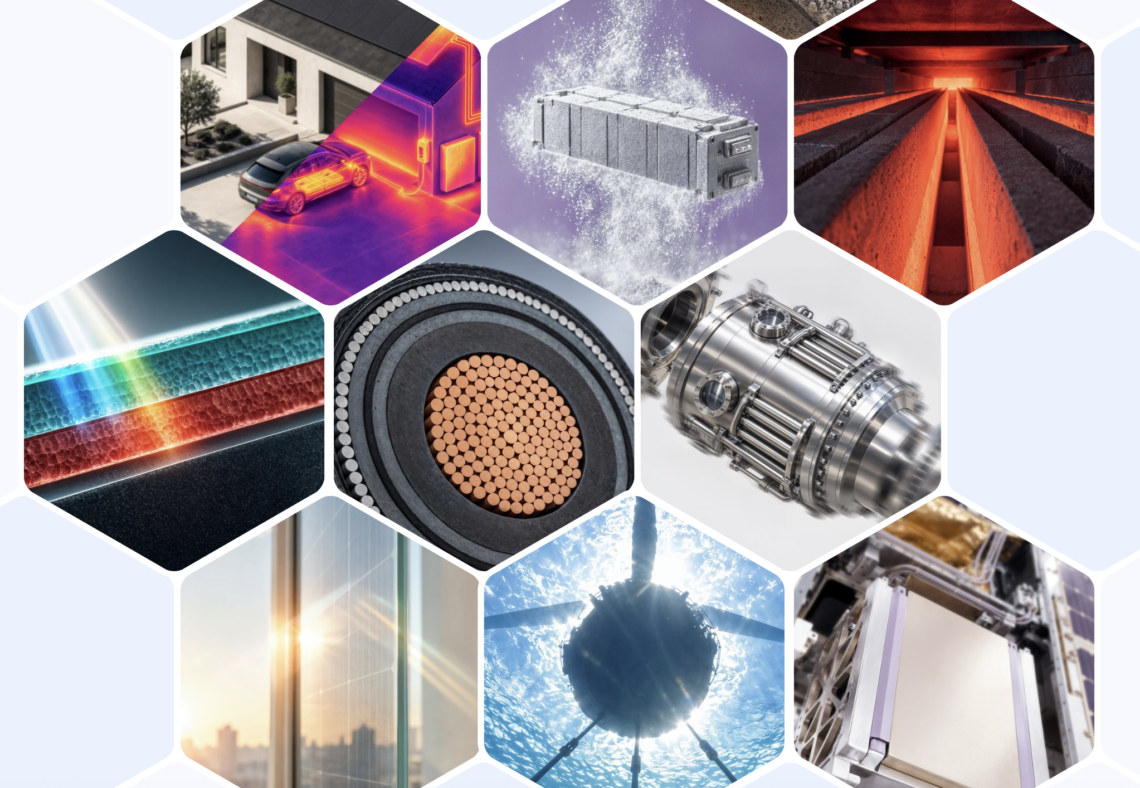
The final ten, in order of rank, are calcined-clay limestone cement (LC3), virtual power plants and grids, abundant materials batteries, thermal energy storage (heat batteries), perovskite-silicon tandem solar cells, advanced subsea HVDC interconnectors, modular nuclear reactors, building-integrated photovoltaics, floating offshore wind, and next-generation lithium batteries. The committee had broad consensus on the top five. Each chapter weighs a technology’s benefits against its trade-offs for the planet, for equity, and for security.
A lot of energy technologies and climate tech are extremely hard to deploy and commercialize, says Evelyn Wang, a member of the report’s advisory committee and the inaugural Vice President for Energy and Climate, the Ford Professor of Engineering, and the Director of the Device Research Laboratory at the Massachusetts Institute of Technology (MIT). Heat batteries show significant promise because there has been a lot of progress in how to do it in a scalable and economic way, she says. Decarbonizing industrial heat is the nearest-term breakthrough for thermal storage. “We are already seeing significant piloting and demonstrations of the technology, which is a key part of overcoming the valley of death,” she says. Eventually the hope is that the industrial heat could be turned back into electricity, but that is further away because it will require the development of high-efficiency, low-cost converters.
Banking Cheap Power As Heat
The principle is old. Steel mills have stored heat in brick for centuries. What is new is pairing those materials with cheap renewable electricity and software that decides when to charge. Depending on the design, heat batteries reach temperatures of 1,000°C to 2,400°C and discharge on demand as steam or scorching air fed directly into factory boilers.
Germany will soon offer one of the first big tests in European heavy industry. Chemicals maker Covestro is building a 100-megawatt-hour heat battery at its Brunsbüttel site with California-based Rondo Energy, backed by €75 million from the European Investment Bank and Breakthrough Energy Catalyst. It is scheduled to go into operation by the end of 2026 and supply about 10% of the site’s steam, cutting up to 13,000 metric tons of CO2 a year. Covestro has said it will use the experience to decide whether to deploy the technology more widely.
The report also points to a business model that removes the biggest hurdle for cautious manufacturers: upfront cost. In 2025, a corn-processing plant in Hungary that had run on gas for years switched to a heat battery built and owned by Norway’s Kyoto Group. Kyoto carries the risk if anything goes wrong. The plant simply pays for the heat it uses, as it once paid its gas bill, under a 15-year agreement.
A younger French company is betting on the same approach. Paris-based Epyr, founded in 2024, raised a €15 million Series A in October to sell heat as a service to European industry. Its firebrick unit at WEPA’s paper mill in Troyes is already running, and a larger one is planned for paper maker Papeco. (For more on Epyr, see The Innovator’s Startup of the Week story.)
The largest checks, however, are being written in the U.S. San Jose-based Antora Energy closed a $550 million Series C in August to scale thermal batteries for factories and data centers.
Follow The Tariffs
Two obstacles remain, according to the report. First, every factory needs heat delivered differently, so each installation is still a custom engineering job rather than an off-the-shelf product. Second, electricity markets were not built for this kind of customer. Most industrial tariffs reward steady, predictable demand. A heat battery does the opposite, drawing power in fast bursts whenever it is cheap.
Brussels has started to respond. The European Commission’s Electrification Action Plan proposes cutting network charges for industrial users who shift consumption to off-peak hours, narrowing the price gap that has long favored gas. The report argues that will not be enough on its own, and that regulators will need to go beyond tariff cuts and introduce binding policy.
The benefits will not spread evenly without help, the report’s authors add. Large chemical groups can finance custom projects. Smaller manufacturers may need targeted funding and fairer electricity rates before heat batteries cut their bills.
Trading One Dependency For Another
A theme runs through all 10 chapters: each technology reduces one dependency and often creates another. The report argues that the winners in today’s volatile markets will be technologies that swap an imported tanker or a single overseas supplier for energy a country can build and control itself, or share with neighbors on reliable terms. But it warns that dependencies “can be reduced but rarely removed entirely.”
Batteries made from abundant materials, ranked third, are the clearest example. Sodium, zinc, and iron can be sourced almost anywhere, unlike lithium and cobalt. Yet China supplies an estimated 99% of sodium-ion cells today. Chinese battery giant CATL is now pushing into Europe, most recently with a deal to deploy 3 gigawatt-hours of sodium-ion storage with Germany’s Intilion over five years. European challengers are trying to keep part of the supply chain at home. Swedish startup Altris has partnered with Czech chemicals group Draslovka, which made a €19.3 million in-kind investment, to convert a line in Kolín to make Altris’ sodium-ion cathode material. Production was scheduled to begin this fall, at up to 350 metric tons a year, enough for roughly 175 megawatt-hours of cells.
How a technology scales shapes its risk. Solar façades or sodium-ion installations succeed or fail one project at a time. Modular reactors or subsea cables can hinge on a handful of projects, so a single cancellation, such as NuScale’s first U.S. plant in 2023, can look like proof a technology doesn’t work even when the economics haven’t changed.
Even the top-ranked technology faces a version of this. LC3 cement replaces about half the clinker in ordinary cement and cuts emissions by up to 40%. European standards have allowed it since 2021. The bottleneck now is procurement. Public buyers still tend to specify cement by its ingredient list rather than by its performance.
Decisions Made Now
Getting the technology right does not guarantee getting the outcome right, the report concludes. A solar façade may lower a building’s electricity bill, but tenants will not share the savings unless a lease or regulation says so. An offshore wind farm may create jobs, but not necessarily for the fishing communities that use those waters. A battery factory built on abundant minerals can still concentrate the jobs in one country.
The window to settle those questions is short. Every technology on the list was chosen because it has a credible path to deployment by 2030. That means the contracts, standards, and siting choices that determine who benefits are being made now, while the technologies are still being built.
For heat batteries, the first answers will come soon. If Covestro’s Brunsbüttel unit performs as promised and Brussels follows through on electricity pricing, Europe’s factories could start replacing imported gas with heat stored from their own grids’ surplus power.