
Epyr, a Paris-based thermal energy storage startup, is tackling one of the biggest challenges in the energy transition: the decarbonization of industrial heat, a segment that accounts for almost 25% of global energy consumption and remains largely reliant on fossil fuels.
Epyr’s system draws electricity from the grid whenever it is cheaper than gas and uses it to power electric resistors that heat air, which in turn heats firebricks — high-performance ceramic materials that store the energy. The stored energy doesn’t need to be consumed when it is generated. It is discharged on demand as high-pressure steam directly into the factory’s steam network, providing a fully decarbonized source of heat for manufacturers.
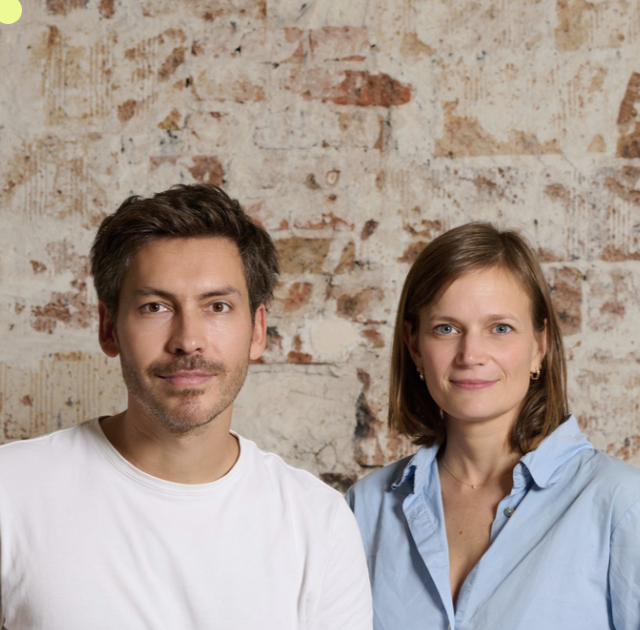
“It is an amazing opportunity to move the needle on the decarbonization of industrial heat,” says Léa Dardenne, who co-founded the company with Bastien Oggeri in 2024. Oggeri, who previously co-founded the agritech company Innovafeed, and Dardenne, who worked on energy strategy at the Boston Consulting Group and within the French government, decided to join forces to bridge what they describe as “the missing link between the complexity of industrial-heat decarbonization and the potential of electrification.”
Thermal energy storage, which uses electricity to heat low-cost, durable materials with high heat resistance, such as sand, firebrick, carbon blocks, or molten salt, is one of the Top 10 Emerging Technologies for Planetary Health named in a November 13 report by the World Economic Forum, in collaboration with Frontiers, the open-science publisher. This year’s edition of the report focused specifically on energy-sector innovations because “the way the world generates, moves and stores energy affects nearly every planetary boundary under strain.” (See The Innovator’s separate story about the 10 energy technology approaches mentioned in the report.)
Epyr is currently focusing on mid-temperature heat (150°C to 500°C), which the Fraunhofer Institute, Germany’s network of research organizations, says represents about 40% of industrial heat demand, notably in the paper, food, and chemical sectors. “These processes, which rely on steam or another heat-transfer medium, are highly standardized and easy to integrate, almost plug and play. Higher-temperature hot air is feasible but more complex, as it often interfaces directly with core process steps,” Dardenne says.
Epyr’s first industrial unit, inaugurated in May 2026 at German hygiene paper manufacturer WEPA Group’s mill in Troyes, France, was built and commissioned in under six months and supplies up to 25% of the site’s steam. WEPA needs a significant amount of heat to dry paper pulp. “We wanted to move fast from idea to product to show that the approach is valid and that the equipment needed is simple, reliable, and easy to implement,” says Dardenne.
In October, Epyr raised a €15 million Series A, led by SlateVC, to accelerate deployments, starting with a 35 MWh unit at the Orval-sur-Sienne site of Papeco, a French company that manufactures and converts eco-friendly sanitary and industrial absorbent paper products. The project, which is set to be France’s largest thermal energy storage installation, is being designed to eventually replace the site’s entire natural gas use. This required Epyr to change the design of its product to handle larger storage so it could meet the full heat requirements of factories that eliminate boilers entirely. Dardenne says the choice is up to clients and “the risk the factory wants to take.” Clients have the option to keep their existing gas boilers and use whichever solution is cheaper at any given moment, depending on the price of electricity and gas, or to go purely electric and move away from gas. “We allow them to do it progressively,” she says. “They can start with us and maybe one or two years down the line decide to decommission the boilers.”
Dardenne says some clients want to own the assets, while others prefer to focus on their core business and opt for heat-as-a-service models. Who bears the energy risk depends on the contract. “Sometimes the risk is shared,” she says.
Thermal energy storage can deliver heat 10% to 30% cheaper than gas, she says, which is driving real interest from clients. Epyr buys power from the grid at spot prices and signs power purchase agreements with renewable generators. “We can do both, but today spot prices are more competitive,” she says.
France’s low-carbon grid gives Epyr an edge, says Dardenne. Electricity in France is among the cheapest and cleanest in Europe, so “when you electrify, you decarbonize.”
Epyr’s pitch is not just decarbonization but energy sovereignty. Europe’s gas-price shock has changed conversations with industrial buyers, she says. “In Europe, we are exposed to geopolitics,” says Dardenne. “If we want to be competitive and have control over energy prices, we need to find other forms of energy, and this can only be achieved through renewables.”
Germany, Belgium, the Netherlands, Iberia, and the Nordics are good candidates for expansion, she says.
By storing renewable power and releasing it as heat when required, Epyr’s system supports France’s and Europe’s power grids as they become more decentralized and more reliant on intermittent sources, and helps make renewable energy accessible and economically viable for industrial players, she says.
Epyr has a pipeline of more than 60 industrial projects throughout Europe, says Dardenne.
On June 18, Epyr was named a winner of the 10th edition of the Prix EDF Pulse, the French electricity giant’s flagship startup competition recognizing innovations that drive the energy transition. Epyr won in the Accelerate and Expand Electrification category for its thermal storage system.
Companies such as Rondo Energy, Antora Energy, and Kraftblock are also focused on the industrial heat market. Dardenne says Epyr stands out less for its equipment than for its turnkey offer, which bundles technology, system integration, operations, energy management, and financing, so clients can decarbonize without upfront investment. “We handle energy management and operation on power markets, and others don’t,” she says.
The company has raised a total of €18 million in financing to date.