
On the Swiss avalanche scale, level 3 is the most dangerous, not because it is the highest, but because it is the one people think they can manage. That, Swiss State Secretary Alexandre Fasel told the GESDA Anticipation Summit in Geneva this week, is where most of today’s science and technology risks now sit.
The summit, which drew about 900 participants, including scientists, policymakers, academics, NGOs, and technology companies, launched the 2027 Science Breakthrough Radar, which maps advances expected to shape societies over the next five, 10, and 25 years. The Radar draws on the cumulative contributions of more than 2,400 scientists in more than 90 countries.
The Radar’s latest findings highlight the potential impact of five fields in particular:
- Robotics and Embodied Intelligence: As AI leaves our screens to inhabit machines, it will automate dull, dirty, and dangerous jobs and enable exciting new use cases.
- Future Therapeutics: Advances in targeted gene therapies and immune “hacking” could bring breakthroughs in the treatment of cancer, viral infections, and autoimmune diseases.
- Mathematics: New mathematical tools will help us understand human-climate feedbacks and speed up progress in biology and medicine.
- Fungal Biology: Fungal enzymes promise breakthroughs in greener biofuels, wastewater treatment, and anti-aging drugs.
- Artificial Intelligence: AI will speed up scientific research and conduct experiments, shifting the role of humans toward framing problems.
The summit’s central challenge is to translate those assessments of emerging advances, and the risks associated with them, into anticipatory action through practical cooperation among governments, research institutions, and industry.
Attendees grappled with a host of thorny questions, including: When we build living systems from scratch, who decides what gets made? How do we prevent biology from being weaponized? What must embodied AI learn to live with us? What are the dangers as brain-computer interfaces enter consumer markets? A CRISPR experiment now costs less than a coffee in Geneva: What are the implications for human health and society? After the ISS, who sets the rules in space? How can we best balance public purpose with private gain and ensure that space does not become the domain of only the world’s most powerful countries and companies?
AI Outpaces the Rules
The Innovator’s editor-in-chief moderated three sessions on AI, which focused on how the technology is reshaping science and society faster than the rules can keep up.
The first session, a fireside chat with Hiroaki Kitano, president and CEO of Sony Computer Science Laboratories, focused on how AI is changing science. Kitano said AI is enabling science to operate at warp speed and make breakthrough discoveries that were not possible before. He talked about the need for more biological data and the international cooperation that will require. He said the technology will free up scientists’ time, augmenting but not replacing them. AI applied to science needs more than large language models: World models will be essential, as will high-precision simulation, said Kitano.
But physical AI could cause material harm through uncontrolled robots, hazardous chemical synthesis, or engineered biological agents, he said.
In August, The New York Times reported that scientists had already used AI to create new kinds of viruses, fueling hopes for medical advances but also raising the disturbing possibility that the technology could someday be used to invent dangerous pathogens.
Kitano proposed safeguards that could include capability restrictions, auditing, AI regulation, biosafety rules, synthesis-level controls, and access verification for sensitive biological tools.
How to regulate dual-use biological capabilities without blocking legitimate research remains an open question, said Kitano. The line between what could be good or bad for humanity is not always clear-cut.
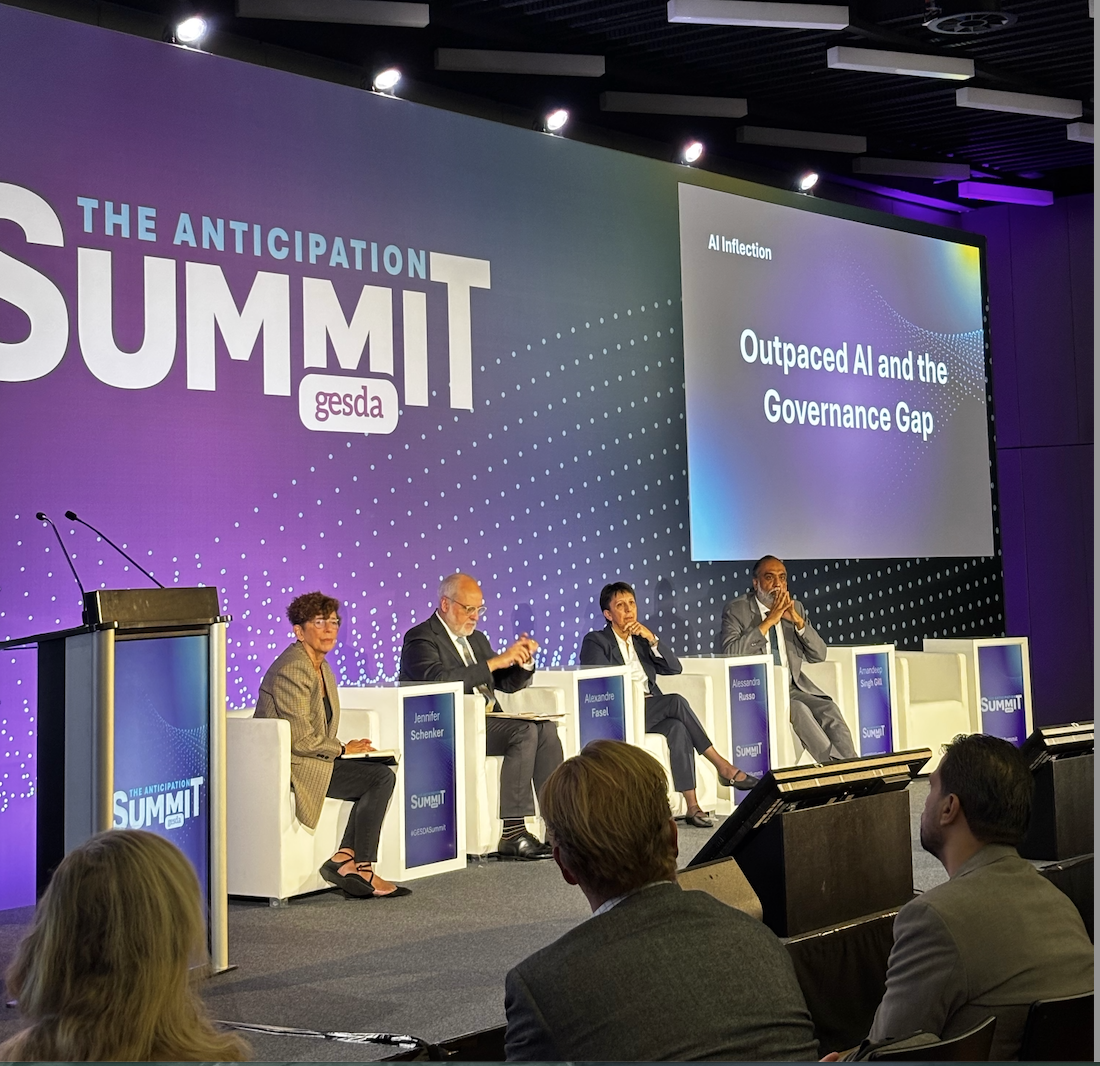
A panel titled “Outpaced: AI and the Governance Gap” (pictured) included Fasel who delivered both the opening and closing keynotes on the summit’s first day; Alessandra Russo, professor in applied computational logic and convening co-director of the School of Convergence Science in Human and Artificial Intelligence at Imperial College London; and Amandeep Gill, UN under-secretary-general and special envoy for digital and emerging technologies.
Gill said the dangers posed by AI—and the need to regulate the technology—are top of mind. He had just returned from a cybersecurity conference in Singapore, where the issue was one of the main topics.
Russo said that along with establishing ways to monitor agent behavior and to hold developers, the companies that sell the technology, and users liable, it is important to change the way AI models are trained and to embed red lines directly into the technology.
Fasel talked about how Switzerland is preparing to host the AI Summit Geneva 2027, a global conference that follows previous summits in the UK, South Korea, France, and India. Asked what concrete deliverable would make the Geneva summit a success, Fasel did not name one, saying instead that global conferences are helping the international community grasp the issues and reach consensus on how to handle them.
A third panel focused on how AI’s physical backbone—data centers, fiber-optic cables, and spectrum—has become a front line. In March, Iranian drones struck three Amazon Web Services data centers, two in the United Arab Emirates and one in Bahrain, in the first publicly confirmed military attack on a hyperscale cloud provider. Ships have dragged anchors across cables in the Baltic, and two subsea cables were damaged in a protected zone off Perth, Australia. Chinese state-sponsored hackers known as Salt Typhoon have burrowed into telephone networks in some 80 countries and may still be there. Jamming of satellite signals has become routine, as have combined cyber and kinetic attacks. Marco Criscuolo, director of strategy and policy for cyber and digital transformation at NATO, and NTT Chairman Jun Sawada talked about where infrastructure is most exposed and what their respective organizations are doing to protect it.
Another AI session, which The Innovator did not moderate, examined the use of AI on the battlefield and how it is already changing how targets are chosen. Jürg Lauber, vice president of the International Committee of the Red Cross, warned against the narrative that AI will make war more humane. It will not, he said.
Elke Schwarz, a professor of political theory at Queen Mary University of London, warned that “when we prioritize speed and optimization, it changes our relationship to our use of force,” she said. “Everything is rendered into a data point.”
Panelists agreed that the longer accelerated autonomous systems are allowed to run unchecked, the harder it will be to rein them in. “The best idea is to embed legal compliance into the systems from the beginning, to ensure they are human-centered and that humans control AI and not the other way around,” said Park Jin, who served as South Korea’s minister of foreign affairs from May 2022 to January 2024.
Governing Neuroscience
GESDA sessions also focused on the ethical issues and regulatory challenges posed by the convergence of AI and neurotechnology. Both UNESCO and the EU are working on how these issues should be handled. A private workshop at the GESDA summit examined that work and discussed how best to move it forward. The Innovator was allowed to sit in, but the workshop operated under the Chatham House Rule, so no one participating can be quoted by name.
Participants argued that attention should be paid not only to whether a particular neurotechnology device is safe, effective, and privacy-preserving, but also to how neural and behavioral data are collected and used.
Questions for policymakers include who is able to collect and aggregate neurodata at scale, who develops and controls foundation models, who defines technical and scientific standards, who has the authority to validate performance and safety claims, who captures the benefits of downstream applications, and who is exposed to the social, economic, and political risks of their deployment.
Anticipating The Darker Side
In his closing speech on the first day, Fasel said, “the greatest risks are rarely what we fear. It is the ones we stop paying attention to.” That is why it is important to talk about risks and not just opportunities, he said. “Through anticipation we preserve our capacity to act rather than react,” said Fasel. “If you anticipate, you nurture your capacity to act and to capture the upside of science and technology. If you don’t anticipate, you are bound to react and be hit by the full force of things you haven’t seen coming, and revert to a moratorium or prohibition, forgoing the benefits.”
The Swiss avalanche report works for one reason, Fasel said: “It is independent, based on evidence, reviewed and updated every single day.” That is what the world needs for science and technology, he said: “A trusted place where evidence is shared, uncertainty is admitted, different actors rely on the same bulletin, and based on it form their judgment and act upon it.”
Science now has its avalanche bulletin. The question for the AI Summit Geneva 2027 is whether governments read it before they head up the mountain.