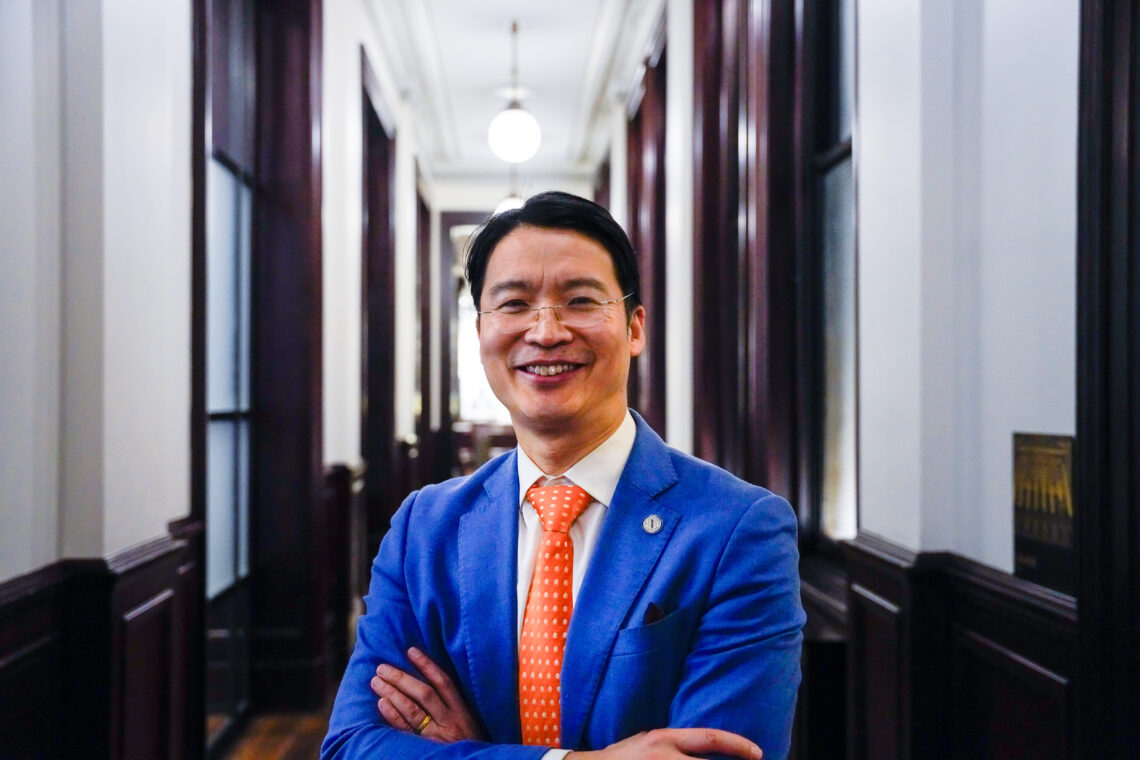

Winston Ma is an investor, attorney, author, and adjunct professor focused on the global AI economy. He is a partner at Dragon Global, an AI-focused family office, and he is also the executive director of Global Public Investment Funds Forum and an Adjunct Professor (focused on sovereign investors) at New York University (NYU) School of Law.
Most recently he was managing director and head of the North America office for China Investment Corporation (CIC), China’s sovereign wealth fund. Prior to that, Ma served as the deputy head of equity capital markets at Barclays Capital, a vice president at J.P. Morgan investment banking, and a corporate lawyer at Davis Polk & Wardwell LLP. He is one of a small number of native Chinese who have worked as investment professionals and practicing capital markets attorneys in both the United States and China.
A certified software programmer, Ma is the author of more than 10 books on sovereign wealth funds, the digital economy, and global geopolitics, including The Hunt for Unicorns: How Sovereign Funds Are Reshaping Investment in the Digital Economy. He was selected as a 2013 Young Global Leader by the World Economic Forum (WEF), and in 2014 he received the NYU Distinguished Alumni Award. Ma recently spoke to The Innovator about his new book, “Who Owns AI? Sovereign Wealth Funds, State Ownership, and the Race for Sovereign AI”, which will be published next month by One Button Publishing.
Q: Your new book is entitled “Who Owns AI? Who, in your opinion, should own it?
WM: A genuine consensus is emerging that AI-generated wealth requires its own dedicated sovereign vehicle: an AI sovereign wealth fund. In the U.S., a socialist senator, a Republican administration, the CEO of OpenAI, and the CEO of Meta (Facebook) have independently and, for different reasons, endorsed some version of that premise within a single twelve-month period. Across the Pacific, China’s own National AI Fund and models being developed or discussed by other Asian countries demonstrate that the same conclusion is being reached well beyond America. The reason for this is that three distinct parties have a legitimate claim on AI-generated wealth, and the central argument of my book is that no single claim, pursued alone, can resolve the governance question because each requires the others to function.
Q: Please explain who the three parties are and what their claim is.
WM: The first party is, of course, the private companies — the AI laboratories that train frontier models at private expense and private risk. They are their models’ owners, and the wealth those models generate belongs, in the first instance, to the shareholders who financed their construction. But they don’t have the only claim.
The public has a claim because AI models are trained on a resource more valuable than any single company’s own capital: data — the accumulated knowledge and labor of humanity, continuously renewed by the billions of people each day. If that resource is genuinely public, the argument follows, some share of the value built on it should be genuinely public as well.
The Sovereign (Government/State) Claim: This claim operationalizes the public claim. While citizens can assert that training data is a public resource, only a state can classify data, build pricing exchanges, secure power grids, and supervise the physical supply chain.
Mapping the AI stack — adapting the five-layer architecture Nvidia CEO Jensen Huang presented at Davos in January 2026 — energy at the base, then chips and compute, then cloud infrastructure, then the models themselves, then applications at the top — shows that the base layer is already state-coordinated, especially in the U.S. and China.
Washington’s Ratepayer Protection Pledge covers roughly 80% of power delivered to American data centers, requiring hyperscalers to fund grid expansion. Beijing’s parallel ¥2 trillion computing-network initiative, financed through sovereign debt and special government bonds, operates on the identical logic. If the base of the stack requires sovereign coordination, the wealth generated at the top cannot be defended as purely private. The sovereign claim acts as the institutional bridge between corporate ownership and public benefit.
As a sovereign investor professor at NYU, I’ve added a sixth layer underneath the five-layer stack from Jensen Huang: the Layer 0 of human capital — the research universities and related talent pipelines. That layer is state-built infrastructure too, the same way the power grid is: decades of public university funding and national research investment, which extends the sovereign claim.
Q: Do you consider it to be a logical next step for governments to create AI sovereign wealth funds given that sovereign funds are already the largest investors in AI?
WM: Exactly. The U.S. sovereign fund (and its Intel investment, among others) is a new phenomenon, but my Hunt for Unicorns book, which was published in 2020, was already talking about how sovereign funds globally — from the Middle East, China, Korea, Singapore, and Southeast Asia — were investing in tech, including AI.
Today government sovereign funds are the biggest investors in AI. Look at Anthropic: it’s the most valuable AI startup (and its CEO said the total addressable market exceeds $30 trillion). Most recently, the two largest rounds were led by Singapore GIC, the Singapore Government Investment Corporation.
The same is true for data centers. There’s a digital infrastructure investment consortium with the potential to invest $100 billion known as the Artificial Intelligence Infrastructure Partnership (AIP), co-led by BlackRock, the world’s largest alternative assets manager, and its subsidiary Global Infrastructure Partners (GIP), as well as a few major sovereign wealth funds, including Singapore’s Temasek, Abu Dhabi’s MGX, and Kuwait’s KIA.
When it comes to public AI stock trading, Norway’s sovereign investment fund is one of the largest public market investors in Nvidia, which dominates the AI chip layer, and it has huge voting power in many AI and tech companies because of its public holdings. These are 100% state-owned investment vehicles investing into the full AI stack.
The year 2026 is the start of a new phase: since public investment funds like those listed above are already financing the entire AI stack, formally establishing AI’s own sovereign wealth funds — such that AI gains can be shared as public benefits — is the natural institutional evolution.
Q: There is a very good reason for governments to invest. The Tony Blair Institute for Global Change noted in a recent report that compute is not just a source of scientific and economic progress, but the new benchmark of global power economically and geopolitically.
WM: It’s not the compute alone; it’s the overall AI stack.
Q: This is why the whole issue of sovereignty has become so important in Europe because it doesn’t control the full stack.
WM: That is precisely the point. True AI sovereignty requires alignment across all five layers: securing energy baseload, manufacturing silicon, building data centers, hosting proprietary or open-weight models, and deploying productivity applications.
China has focused heavily on using sovereign vehicles to capitalize this stack. In addition to the well-known CIC sovereign wealth fund, where I worked as a financial investor managing a global market portfolio, China also established the National Integrated Circuit Industry Investment Fund (“Big Fund”). Its $47.5 billion Phase III, launched in late 2024, directly targets advanced semiconductors, yielding major market listings like ChangXin Memory Technologies (CXMT) — China’s domestic answer to both U.S.-based Micron and South Korea’s Samsung.
In January 2025, Big Fund III co-founded the $8.2 billion National AI Fund. When Chinese AI startup DeepSeek raised its external financing round, the National AI Fund contributed a ¥1 billion check. Although smaller than the non-voting capital injected by commercial giants like Tencent and CATL, the state fund took the only position with direct governance voting rights.
Q: So when the U.S. government takes a 10% share in Intel, they’re essentially copying China?
WM: Exactly. Trump is taking a page out of China’s sovereign AI playbook — that’s the title of my Financial Times op-ed in June.
Q: For democracies, there’s something that makes people feel a little uneasy about government owning stakes in a company that they’re also regulating. And when OpenAI CEO Sam Altman offers to give a 5% stake of his company to the government, not only do you have that issue, but it’s also this question of playing favorites. Where does that leave other players in that space? Isn’t that an issue too?
WM: Agreed — that is the central governance issue of state ownership. When a government holds direct stock in frontier market leaders while acting as their regulator, it creates three severe governance breakdown risks:
- Dual-Role Conflict: The state acts simultaneously as a dominant profit-seeking investor and an impartial market regulator.
- Blurred Fiduciary Duty: National security priorities, political agendas, and commercial shareholder value become conflated.
- Voting Rights Distortion: Unclear boundaries around whether the state exercises ordinary voting rights or golden-share veto authority.
Q: What is your take on U.S. Senator Bernie Sanders’ proposal for an American AI Sovereign Wealth Fund Act, a one-time 50% tax on the stock of major artificial intelligence companies to give the public direct ownership?
WM: Senator Sanders’ bill (proposing a mandatory 50% stock transfer on AI firms earning over $200 million annually to create a $7 trillion fund) and Sam Altman’s voluntary 5% equity donation (about $42.6 billion in value) both incorrectly use the Alaska Permanent Fund as their template.
The Alaska model is the wrong comparison because it was designed to extract value from a depleting, non-renewable resource (oil) and distribute cash dividends directly to citizens. AI is a compounding, productive asset. Treating AI like oil creates political pressure for short-term cash payouts at the expense of continuous reinvestment into energy grids, compute, and open research.
AI is a productive asset, so the gain is cumulative and progressive, and you could even say exponential, so there should be some mechanism to balance distributing the benefits to the broader public and reinvest to get more productivity out of this new technology. It all comes down to who controls and manages the gain.
Q: That’s a great segue into Meta founder Mark Zuckerberg’s proposal in his recent treatise entitled “The Future Is for Everyone: The Path to a Positive AI Future.”
WM: Mark Zuckerberg’s 6,500-word essay proposes a “corporate self-limitation model.” He suggests distributing AI benefits via free access to Meta’s tools and voluntarily directing data center tax revenues into local community funds. However, this leaves the ultimate decision-making power inside corporate boardrooms based on company balance-sheet interests rather than public governance. Voluntary corporate philanthropy is not a substitute for a structured AI sovereign wealth fund.
Q: If, as you argue, governments are best placed to ensure that the public has a balance-sheet position that generates returns rather than merely income to be taxed and spent, can you point to any governments that are doing this well?
WM: Singapore’s Temasek offers the closest precedent, because it has spent five decades solving the specific problem Alaska and Norway both avoid rather than solve: holding majority stakes in domestic champions — DBS, Singtel among them — without collapsing into the shareholder-regulator conflict its critics predict.
The structural mechanism is precise. Temasek is a Fifth Schedule entity under Singapore’s own constitution, governed by an eleven-member board that, as of March of this year, included no nominees of the Singapore government at all. Its own leadership has described the resulting independence in the plainest possible terms: when Singtel, a Temasek portfolio company, moved to acquire a major regional rival, it did not consult Temasek.
As of the fiscal year ending March 31 of this year, Temasek’s own net portfolio value stood at S$518 billion, roughly double its level a decade earlier, with twenty-year and ten-year total shareholder returns of 6.8% and 7.1% respectively — evidence of a compounding, not merely a distributing, institution. Temasek’s own dividend policy returns up to half its expected long-term gains to the Singapore government’s budget, funding roughly a fifth of annual public spending, while compounding the remainder.
However, in April, Temasek announced a restructuring that split it into three distinct entities managing global, domestic, and partnership capital separately, evidence that the “correct” governance design remains a live, evolving question even for the model my book holds up as the closest working template.
Q: Has any government applied the Temasek template to an AI-specific sovereign fund?
WM: Yes, South Korea has, over the course of 2026. In May, a presidential adviser’s social media post floating a citizen dividend funded by AI tax revenue drove the Korea Composite Stock Price Index down 5.1% intraday — direct market evidence that Sanders-style redistribution proposals carry a measurable volatility cost even at the proposal stage.
Deputy Prime Minister Koo Yun-cheol’s response on May 30 set a different direction explicitly: reinvestment over distribution, structured on Temasek’s own model, following a delegation that Korea’s finance ministry had already sent to Singapore in late March specifically to study Temasek’s governance firsthand. Regardless of its ultimate form, South Korea’s emerging AI sovereign wealth fund provides a vital reference for structural design in both China and the United States, underscoring that the policy debate is now genuinely global.
Q: What are the key points you want people to take away from your new book?
WM: We are moving beyond sovereign capital investing into AI companies — they are already the largest, established tech investors. The frontier question is about AI’s own sovereign wealth fund, turning AI gains into public benefits.
The global debate now is no longer about whether AI requires a dedicated sovereign wealth fund — that consensus is already formed in Washington, Beijing, and Seoul. The unresolved challenge is what kind. The decade ahead depends on building an institutional governance structure that allows a state to hold real equity in the companies building the technology it also regulates, without conflict of interest or the redistribution failure that leaves nothing to compound.
The interview was conducted by the author. AI was used to copy edit the Q &A.