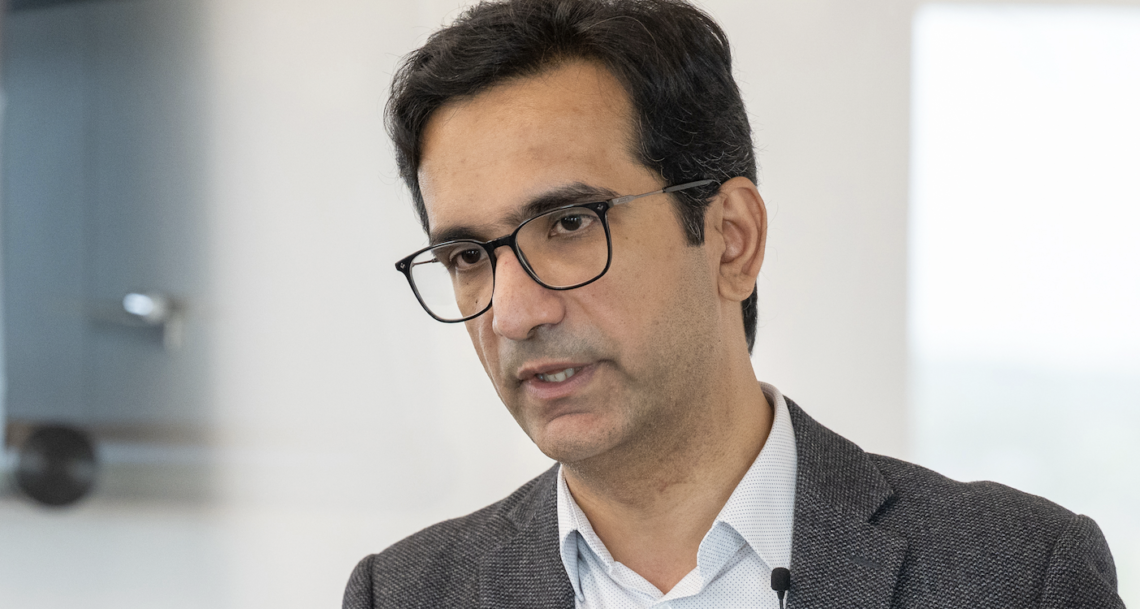

Mehran Gul is the author of The New Geography of Innovation (William Collins / Simon & Schuster), recipient of the Financial Times/McKinsey Bracken Bower Prize, and an FT Best Book of the Year selection. He previously worked at the World Economic Forum and attended Yale where he was a Fulbright Scholar, Fox International Fellow, and Teaching Fellow. Gul, a scheduled speaker at the GESDA conference in Geneva October 14 to 16, recently spoke to The Innovator about the geography and geopolitics of technology and science innovation.
Q: What drove you to write about the new geography of innovation, and what are the key takeaways?
MG: Let me start with why write about the new geography of innovation at all? If you go back to around COVID, in 2020, the conversation about technology in the U.S., and especially in Silicon Valley, was very different from what it is today. The world started talkinabout AI only in November 2022, and now it is all we talk about.
Before that, during COVID, people were asking: Is Silicon Valley over? Is America’s relevance not just to technology but to global power on its way down? And it wasn’t just popular sentiment. As far back as 2018, Alan Greenspan, the former chair of the Federal Reserve, who ran the Fed for nearly two decades and is one of the most important American economists, co-authored a book called Capitalism in America. It argued that the creative destruction that set the U.S. apart from Europe and Asia was waning and that America was beginning to look more like its European peers. So, it seemed like a good moment to take a closer look at the predictions of Silicon Valley’s decline, of innovation moving to the cloud, and of things becoming decentralized.
Q: Given the AI zeitgeist, would you still write the book today?
MG: I think I would, although the conclusions I reached were very different from what I expected. In 2020, I really did think that American decline was worth examining. But from the vantage point of 2026, when just 10 American tech companies are worth more than the GDP of every country in the world except the U.S. itself it is very hard to argue that American technological supremacy is in decline. In the rest of the world, a trillion-dollar company is still incredibly rare; in the U.S. tech community, it is almost becoming the norm. People expect OpenAI, Anthropic, and SpaceX to debut as trillion-dollar companies. China doesn’t have a single trillion-dollar company.
But would I write the same book? Yes. Twenty-five years ago, the U.S. pretty much stood alone at the top of the pecking order. Today China is clearly there as well, and in AI, EVs, and solar it is giving the U.S. a run for its money. So even if U.S. decline isn’t real, the U.S. does not have to decline for the rest of the world to rise. You see that in how important companies such as Samsung, SK Hynix, TSMC, and ASML have become. It’s an interesting question to ask: What is the most important company in the world? The fact that TSMC, a Taiwanese company, is a plausible contender shows that the geography of innovation has changed, even if the U.S. is still at the very top.
Q: I have been covering innovation outside of the U.S. for decades. There are amazing innovations everywhere. One of the main differences, for me, is that Silicon Valley companies are overcovered by the media and the rest of the world is undercovered, partly because the only global media come out of the U.S. or the U.K., so coverage is completely skewed.
MG: Absolutely, and you see that skew in company valuations as well. I often caution people not to read too much into the fact that Anthropic is worth $2 trillion at this point while Moonshot AI is worth only $40 billion. That doesn’t mean Anthropic is 50 times more innovative or market-relevant than Moonshot. The difference is that the world’s money chases American companies. Anthropic has Middle Eastern money, East Asian money, money from Singapore, and money from sovereign wealth funds all over the world. Chinese companies, on the other hand, are mostly capitalized by local funds. So it’s not just media attention that goes to American companies; it’s financial attention as well. Imagine how much more valuable Samsung or Tencent would be if they were based in the U.S.
It is important to note that price tags are often a bad indicator of how important a company is. If you look at the valuations of companies like OpenAI, Anthropic, and SpaceX, maybe only 5% to 10% is based on hard facts — what they can do today. Most of the valuation rests on projections about capabilities that don’t exist yet. One VC said 80% of the valuation is in tweets, blog posts, and essays these people have written.
Q: Fei-Fei Li’s company just sold to AMD for $8 billion, and it doesn’t turn a profit
MG: Safe Superintelligence (SSI), Ilya Sutskever’s company: same story. Thinking Machines Lab, Mira Murati’s company: same story. None of them are making money. I think Fei-Fei Li’s company was set up specifically to raise a lot of money and be acqui-hired.
Q: What were the key conclusions of your book? If innovation is not limited to Silicon Valley, what does that mean for the world and for business?
A: The book examined whether American technological supremacy is in decline. The first conclusion is that it is not; some of the most important companies are still in the U.S.
The second conclusion is that we still tend to dismiss China as a copycat, or, in the newer version, to say that China scales: The U.S. goes from zero to one, and China goes from one to 100; the U.S. is better at invention, and China is better at deployment. I found very little evidence of that. Even at the invention layer, a lot of impressive work is happening in China. To give you an example, the world’s most cited paper in artificial intelligence, the ResNet paper, came out of a lab in Beijing, and all four of its co-authors got their undergraduate, graduate, and PhD degrees in China. None of them had studied or worked outside China before writing a paper that is today the most cited paper of the 21st century — not just in AI, but in any scientific field, including physics, chemistry, and math.I’m citing Nature, which published a ranking of the 100 most cited scientific papers of the 21st century. Paper No. 1 came out of China. In addition, 41 of the 100 most cited papers in artificial intelligence were authored in China, and of the 15 institutions that produce the most cited AI papers, 10 are Chinese and 11 are Asian. That includes both companies and universities.
So, the challenge from China is much more serious than we sometimes think. It’s not just zero to one versus one to 100. We often still think about AI as a doomsday scenario in which China could one day be ahead of the U.S. But there are many industries where China is already ahead. Seven out of 10 EVs are manufactured in China. All 10 of the world’s most important lithium-ion battery manufacturers are Asian, most of them Chinese. Seventy percent of the world’s drone market belongs to just one Chinese company, DJI. So for me, the question is: If China can be ahead in EVs, solar, drones, and lithium-ion batteries, what is so special about AI that it cannot take the lead there as well? Even if valuations put the U.S. multiples ahead of China, the competition is much closer than we sometimes make it out to be.
My third conclusion is that we still have a very dismissive attitude toward the rest of the world when it comes to technology — that it just doesn’t matter. But who wins between the U.S. and China depends not only on who develops better technologies but also on who is able to pull other countries into its orbit. Whose AI models or compute infrastructure will Africa run on? Whose models will Singapore’s government run on? The operating system of the AI economy is not going to be determined just by the U.S. and China. Third countries will help determine it, and they also provide very important resources.
My last point on this: The most important breakthroughs in deep learning came from Canada, from Geoffrey Hinton and Yoshua Bengio, for instance. DeepMind was a U.K. company. Hugging Face was founded by two French men. ASML is a Dutch company. That’s why we need to look at other countries as well. Even if they can’t compete with the U.S. and China, they can determine the direction of the contest between the two.
Q: When I covered the AI summit in France, there was a lot of discussion about the rest of the world coming together around open-source AI: Countries don’t have to rebuild everything from scratch; they can use open source for the bottom layers and fine-tune the upper layers of the stack to their own needs, because every country wants its own culture and edge. There was talk of a third way that would keep countries from being locked into either a U.S. or a Chinese architecture. Do you see that as realistically possible?
A: The only viable models we have seen come from outside the U.S. and China are Mistral and Cohere, and Cohere’s usage numbers are even below Mistral’s.
Q: I attended a closed-door meeting in Portugal where the heads of a number of companies shared their experiences with AI and their fears. Many of them are very wary of becoming too dependent on U.S. or even Chinese models, especially U.S. models, because they feel the U.S. government is so unpredictable right now. What if it decides to just turn off the faucet? That fear is real, and I think it is pushing more businesses to consider open source or an alternative like Mistral, because they don’t want to be locked in.
MG: Concern about U.S. models really heightened after the Mythos episode over the summer; after that, the rest of the world started asking that question. Still, I see Mistral and Cohere as sovereign AI plays. Governments are really holding them up, and I can certainly see why governments might be interested in adopting domestically developed AI models. For the private sector, though, the benefit of an open-source model over a closed-source one — even if the open-source model comes from China — is that you can inspect it properly and check for security implications in a way you cannot with a model from Anthropic or OpenAI, for instance. If the only argument for using a French or Canadian model is security, then the fact that Chinese companies are more than willing to completely open-source their models, so you can examine them inside out, takes away the competitive advantage a Mistral would have. The use case I see for Mistral is where you need to be not 99% sure but 100% sure that a model is reliable: defense, government, and medicine. But for most businesses whose operations aren’t that sensitive, at a time when even Apple and Airbnb are using models from Alibaba, it’s becoming hard to justify paying that much more for a French model than for a Chinese one because of security concerns.
Q: That leaves us in the current situation: a reckless race between the U.S. and China for dominance, in which safety concerns are thrown out the window. We have spent years having summits and discussions at the UN, the OECD, and elsewhere, ad nauseam, and nothing happens. It’s all talk. There are no effective, enforceable guardrails in place. So what do we do?
MG: The question is, who would put those guardrails in place? AI is so advanced and so lucrative that the companies making it are the only ones who understand what they are making. Nobody in the U.S. government has the technical capability to comment on the safety of what Anthropic or OpenAI is doing. Talent capable of doing that can command compensation in the millions at one of these companies, so why would they go to work for the AI equivalent of the DMV [Department of Motor Vehicles]? There’s a structural problem: Even assessing what these companies are doing requires a very high level of competence in the domain, and it’s highly unlikely that the U.S. government, or any government, could attract that sort of talent.
The second point I’d make is that AI is moving so quickly that whatever is state of the art today, maybe 20 or 30 labs will be able to do in six months. If Mythos has some mystical capability that makes cybersecurity very weak across the board, in six months there will be 20 companies able to do the same thing. So are we going to develop an elaborate mechanism for addressing AI safety concerns that only matters for six months, before Mistral, a lab in Canada, or multiple labs in China have the same capability? It’s not as simple as saying we’ll create an AI FDA [Federal Drug Administration] to regulate these companies. You can’t make the same argument about pharma companies — that any company can make the same drug in six months — because those capabilities take much longer to develop.
Q: What will your role be at the GESDA conference in Geneva?
MG: I’m moderating three panels. One is about the geopolitics of science, which touches on some of the issues you just raised, not just in AI but across the board. The Director General of CERN is on one of my panels. The question for CERN is whether the same model of cooperation can be applied to AI and other technologies. CERN is seen as a very successful model: Countries that were rivals came together under one body to work on the betterment of science. That model is now under pressure; for instance, CERN cut ties with Russian scientists in the wake of the war in Ukraine. So, one question is whether that model is as aspirational as we initially thought, given that it is under strain.
Another panel includes the president of [Swiss university] EPFL and looks more broadly at the geopolitics of science: whether we are seeing more fragmentation among countries when it comes to international collaboration. We are seeing fragmentation between the U.S. and China, which used to be each other’s primary partners in scientific collaboration.
Q: What impact do you see from the fact that countries are collaborating and sharing less? COVID, of course, is the model everyone points to now: Look at what we can do when we come together.
MG: Some of the implications are quite clear: I think it does hold back progress in science, and you would probably hear that from a lot of people. But I’ve also heard an opposite perspective. The U.S. is becoming a less welcoming place for talent from the rest of the world, especially scientific talent from places like China and India. And, as you would know as well as anyone, being in France, the U.S. has become a lot less popular in Europe this year, especially since the Greenland episode, including in scientific circles. With the best talent no longer welcome in the U.S., countries that were previously losing that talent benefit.
For my book, I interviewed the founder of Proxima Fusion, a fusion startup. He is super smart — he studied at MIT, EPFL, and Imperial — and he decided to start his company in Germany, even though he had every opportunity to do it in San Francisco or New York. So, in that respect, it’s maybe not such a bad thing that more countries are able to retain more of their top talent. If you go to Munich, which is now called the deep-tech capital of Europe, and the surrounding region, you see a lot of deep-tech companies, such as Rocket Factory Augsburg. ambitious companies are coming up in these places.
In the U.K., I’ve seen more of a trend toward founders not selling their companies to the U.S. People have learned the lesson of DeepMind, was acquired by Google in 2014, for a reported $400 million to $650 million; now its competitors are worth a trillion dollars, and DeepMind is a division within Google.
Q: What would you like readers to take away from this interview?
MG:: Innovation doesn’t need to look the way it does in the U.S. and China to be called innovation. In the U.S., the concept has become all about venture-backed companies getting to a trillion-dollar, or half-trillion-dollar, valuation as fast as possible, and that misses important things like government innovation. In the U.S. today, there isn’t even an expectation that the government, in its functioning, can be an imaginative actor. In Singapore, by contrast, the government is a leading example of how technology can be used at scale.
In Switzerland, you don’t have Googles or Facebooks, but you have the Swiss rail system, which has been all-electric since the 1960s. At a time when we still think of electric cars as cutting-edge technology, the fact that there is a country with a cost-effective, publicly run, electric nationwide transport system shows that there are alternative models of innovation.
I could give example after example. In South Korea, innovation does not equal startups. It happens in old companies like Samsung and SK Hynix. How can old companies stay innovative? South Korea has answered that question better than China or the U.S. So, we shouldn’t look at other countries just because we are good people who want to include others in the debate. We should look at them because, on a smaller scale, they are proving that other approaches work. With the innovation models of both the US and China now so contested, it’s time to look at alternative approaches to technology that show progress need not come at the high social cost we have learned to accept.
This article is content that would normally only be available to subscribers. Become a subscriber to see what you have been missing