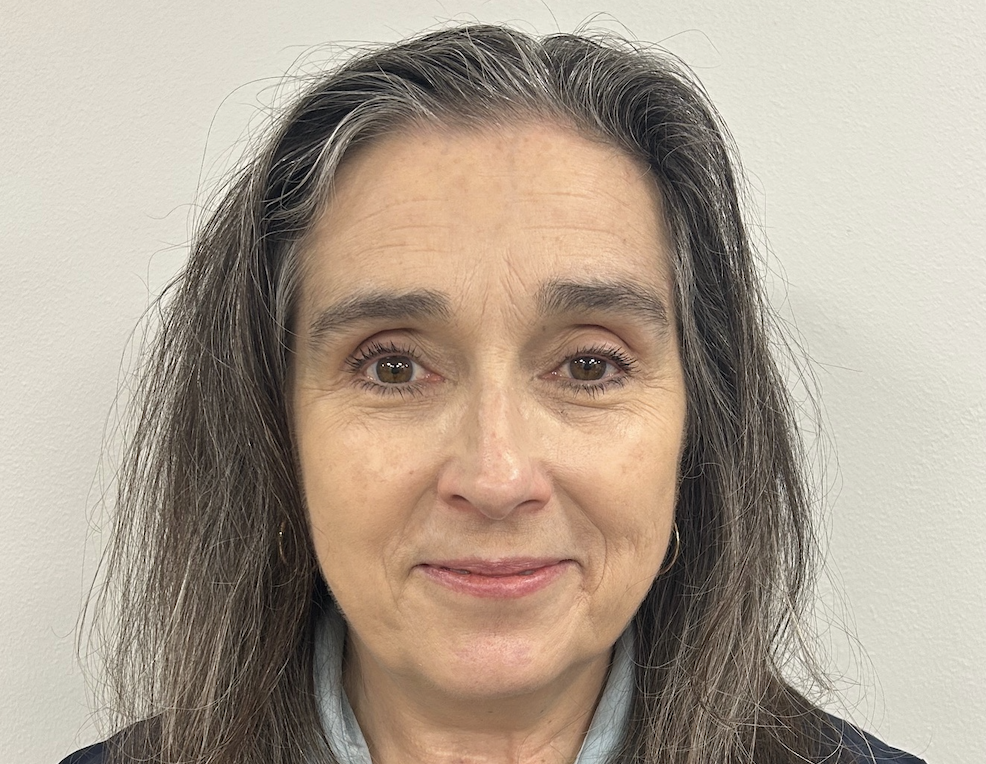

Kimberly S. Budil is the director of Lawrence Livermore National Laboratory (LLNL), where she leads a workforce of approximately 9,000 employees and manages an annual operating budget in excess of $3.25 billion. As director, she sets the strategic vision and leads the Laboratory’s programs and operations to enhance U.S. national security and ensure scientific leadership in strategic areas. She engages with the senior leadership of the Department of Energy, National Nuclear Security Administration, and other federal agencies, as well as senior leaders across government, academia, and the private sector. She serves on several boards and participates in numerous professional and community outreach activities. Budil holds a Ph.D. in engineering and applied science from the University of California, Davis, where she was a Hertz Fellow, and a B.S. in physics from the University of Illinois at Chicago. She is a member of the National Academy of Engineering. She recently spoke to The Innovator about the future of fusion.
Q: The U.S. Department of Energy’s (DOE’s) new fusion roadmap, which was published October 16 last year, outlines how it expects the technology to become a part of the country’s energy mix by the early 2030s. Do you think that is possible?
KB: There are a fair number of fusion companies that expect to demonstrate breakeven, either by 2030 or in the early 2030s. That’s a necessary first step for any potential energy-generating system. I think it’s important to remember that no other facility pursuing any approach to fusion has ever achieved energy breakeven, aside from LLNL’s National Ignition Facility. So that’s a huge hurdle. That said, every time we build a new machine at a new scale, we learn things right out of the gate, so I do expect other machines to cross that energy breakeven threshold over the next 5 to 10 years. Anything this complicated depends a little bit on luck, getting everything exactly right on the first go, and probably a significant amount of learning. You’ll see [Boston-based fusion scale-up] Commonwealth Fusion turn on its Spark machine. Inertia [another U.S.-based fusion company] will be a little bit behind with its demonstration because their timeline is early 2030s for building out their laser. Xcimer Energy [a U.S.-based inertial confinement fusion company] is building a big laser system. You’ve got companies building stellarators and spheromaks [a magnetic confinement fusion approach that uses a magnetic “bottle” to confine extremely hot fusing plasma. Its more compact and simple design compared to other approaches helps drive down costs. A company called CTFusion is one of the groups actively developing this approach]. These approaches are all in that 5-to-10-year realm. Turning that into a commercial energy-generating system is still going to take time after that. The companies all have very aggressive timelines to do that, and I think that’s great. Driving toward aggressive milestones is important, particularly when you have investors. I think the reality says that commercial energy generation is going to be closer to 2040 than 2030, but I’d be delighted to see that timeline move left.
Q: The energy demands of data centers are putting pressure on young fusion companies to speed up development. How do you see AI helping advance the sector?
KB: Commonwealth Fusion’s tokamaks are a good example. There were some early demos of what might be possible in terms of plasma control with AI-driven control systems for the tokamak. Plasma control is a very difficult problem, and so having a very fast, smart control loop that can adapt itself to what’s happening in the tokamak at any given time is going to be an essential piece. That’s one concrete place where AI will definitely contribute to all the magnetically confined approaches. It is a very significant step forward because it is changing the way we can understand the physics of these evolving plasmas, both for inertial confinement or for magnetic confinement or pulse-power-driven fusion. Another application is around the data collected: using AI tools to really explore those data sets and learn how to build better models. Better models allow us to better design target geometries and experimental systems. I think that’s going to be a huge benefit. In the next couple of years, we’ll see our design iteration cycle speeded by AI toolkits, and as the AI models become more capable, they’ll help us in other ways. My colleagues who are doing computational work now, working with the most advanced AI models, talk about having an AI co-researcher sitting with them who can challenge their ideas and who can iterate with them on different approaches. And similarly, for building models, with AI code assistance, an experienced programmer can dramatically improve their productivity. So there’s a whole productivity cycle around design and engineering. We’ve been using AI a lot for design optimization, and for LLNL in particular, the nexus between that kind of design optimization work and new manufacturing approaches like additive manufacturing are allowing us to explore different target geometries that wouldn’t have been possible before. For example, having an entire ICF [Inertial Confinement Fusion] target printed as a single piece — that would be pretty amazing, if you think about commercial-scale production for fusion energy. There are a range of ways AI will impact the field. I think this is an area where partnerships will be important. While AI tools lower the barriers for people to participate, there is no substitute for expertise and compute at scale. I think the national labs have a great service to provide by partnering with these companies.
Q: Aside from AI, there are other opportunities for partnerships with national laboratories. In April, fusion power startup Inertia Enterprises signed agreements with LLNL. Can you tell us about that?
KB: There are a couple of different elements to that partnership, and we’re hard at work with other companies striking similar types of partnerships at various scales. With Inertia specifically, we’re going to work on development of their prototype laser beam line. We bring many decades of experience in building large-scale glass laser systems, including rep-rated glass laser systems. [Rep-rated, short for repetition-rated, refers to a system that can fire repeatedly at a sustained, reliable rate — rather than just once or occasionally. A single fusion shot producing more energy than it consumes (like NIF’s ignition milestone) is impressive scientifically, but a power plant needs to fire many times per second, continuously, to generate useful electricity.] We built a high-power rep-rated system for a European facility, the ELI Beamlines project in the Czech Republic, and Inertia wants to tap into that. They have their own in-house expertise, but of course they can’t muster the kind of laser development experience, optics experience, that we have in house, so that’s a great area for cooperative research and development activities. The second area is in target design. We have decades of experience and a toolkit that no private company can match, and so it’s a great way for us to bring our expertise and our tools to bear on a problem that’s going to be critically important, particularly for inertial fusion-type approaches.
Q: How does the partnership benefit LLNL?
KB: It’s a chance for us to understand more about how we can improve our current laser system. It’s very exciting for us to begin working on next-generation lasers. For our national security missions, we’ve been thinking for some time about what the next facility would be, beyond the National Ignition Facility. This is a chance to do prototype hardware development and explore concepts that we’re considering for a future facility. Our National Ignition Facility was completed in 2009. We’re in the process of refurbishing and upgrading that facility. There are many systems within it that are quite old, just because of the timeline that it takes to build such a complex thing. On the design side, again, it’s a chance for us to really begin to explore different elements of the physics of how these targets work, and to think about different material systems, different target designs, outside the bounds of what we’re doing for our main-line national security work. It’s a way to diversify the work that we’re doing, to test new approaches and experiment by moving a little bit more toward the leading edge in both the physics of the targets and the science and technology of the laser systems.
Q: What other types of collaborations is LLNL interested in?
KB: It might be materials research; many of the national labs are working on materials that will survive in these high-radiation environments. We need to figure out how to get those high-energy neutrons these experiments produce turned into something usable that can be converted into electricity. We also need to think about some of the engineering aspects of building such a large, complex facility. We’ve been working on systems engineering models that will allow companies to explore the kinds of trade-offs you need to make when you build such a large integrated system.
Q: For fusion energy, the challenge isn’t just producing energy — it’s doing it in a way where you get more back than you put in. You hinted earlier this year at a new record yield. What does this milestone unlock scientifically?
KB: Our record yield achievement to date is for 2 megajoules laser energy in, 8.6 out. If you think about what gains you need to get to fusion energy-relevant levels, we’re still pretty distant from that. Gains of 15 to 20 — yields of 30–50 MJ — are what is going to be needed. That said, where we’re trying to get right now is to a place where we’re in a robust ignition regime, so that as we do experiments, we can begin to explore things like how to make the target simpler, or how to accept more variability in the laser energy or imperfections in the target, for example. Our goal has been to steadily push up toward this more robust regime where we can really explore the physics of these targets. The targets, the laser, energy delivery — everything needs to be extremely precise in order for these targets to ignite. More energy, we hope, will make these targets more robust. We saw in the early experiments, a few hundred kilojoules of energy was the difference between not being able to ignite targets and ignition. And now we hope that a few hundred more kilojoules of laser energy will allow us to get above 10 megajoules and into this more robust igniting regime where we can really start to explore the physics. It’s very exciting. It’s a pretty straightforward upgrade to the laser system, and we have a fair bit of the hardware in hand already from when the laser was originally built. I’m very hopeful that this will allow us to get closer to the types of gains that will be required to make an energy system really work.
Q: The Trump administration’s proposed 2026 budget includes cuts to the Department of Energy’s Office of Science. How is LLNL managing that uncertainty, and what’s the risk to NIF’s experimental cadence?
KB: The National Ignition Facility is part of the national nuclear security component of DOE [the U.S. Department of Energy’s] National Nuclear Security Administration. We use the facility to do national security high-energy-density science, and so our budgets are isolated from what’s happening in the Office of Science. Certainly, our hope is that there will be more investment in the new fusion office at DOE to facilitate these partnerships, and that the Fusion Energy Sciences program will continue apace. We’re not anywhere near the point where we’re done learning about these very complex fusion plasmas and systems. Congress gets a vote in how the budget turns out, but from the national security perspective, we’re well supported to continue this work. I’m very excited that we have support to sustain and upgrade the facility, because this is a moment to lean forward on the science. Not to step back.
It does help that China is racing ahead, and there is a real understanding now in the U.S. government that if the U.S. wants to keep pace, it needs to make a big push.
Q: What kind of lead does China have in fusion?
KB: China is making massive investments in fusion. They’re building large-scale fusion facilities for all the various approaches to fusion. They’re building a big laser facility, a big tokamak facility, pulse power, and fission-and-fusion hybrids. They have made it very plain that fusion is a strategic investment area and a strategic area they’d like to lead in in the future. Right now, the U.S. is certainly leading in areas like inertial confinement fusion. No country has come close to what we’ve been able to achieve at the National Ignition Facility, and it’s more than just building a big laser. The estimates for how big the Chinese laser will be when it’s complete suggest it’ll be significantly more energetic. But there’s more to how we do our experiments than just the amount of energy we deliver to these capsules. On the tokamak front, there’s long been international competition. The good news is that the pace of progress across many approaches is really significant in the West. Both U.S. and European companies are pushing hard not to squander — for lack of a better word — the lead that we’ve established over time, and hopefully to cooperate to make sure that the group of countries — which also includes Japan and South Korea — that have worked together so effectively for so long is able to continue to collaborate, even though a lot of the work is going on in the private sector. I hope we’re able to double down on that collaborative environment as we go forward, because we should not have any doubt that a country with the resources and population at the scale of China is a serious competitor.
Q: What keeps you up at night?
KB: I would say first and foremost right now, as we enter this ambitious buildup phase, is that a lot of big promises are being made and they may not be met, not because people are being dishonest, just that it’s harder than it looks. There are some high-profile challenges in the private sector in particular that could lead to a very significant decline in investor confidence in fusion and really set progress back significantly. It is important that people who do not have a dog in the fight make honest judgments about the work that gets done and assessments about the prospects for success as companies inevitably face challenges. I think most of the companies really welcome that. They want to be successful and know this is going to be hard. They share their data, they publish their results, because they know it’s important that the field be credible. Fusion has had a few boom-and-bust cycles before, and we don’t want to see that again.
I’m also concerned that the public investment won’t meet the moment. Fusion companies all need public-sector institutions to step up with specialty facilities, compute, or modeling and simulation tools, or expertise in materials or plasma physics, to really ensure they can be as successful as possible, as quickly as possible. We can’t let public investment lag in an immensely important industry.
I worry that we’ll get through some of these scientific demonstrations and find the path from scientific demonstration to commercial energy generation very hard. This just means that as there are setbacks, the fusion community at large has an obligation to work with lawmakers, the administration, and the public, to help them understand that this is a process and that we can’t achieve big things or these transformational technologies without some bumps along the way. This moment is different, and I don’t want to see us miss it just because it’s hard.
Q: What makes you say that this moment is different?
KB: The state of the science and technology surrounding fusion is fundamentally different than it was even five years ago. When we set out to build the National Ignition Facility 30 years ago, the goal was to build a 10-megajoule laser because we were quite confident that would be enough to make these experiments work. The technology wasn’t ready to do that, so we scaled back to the absolute minimum we thought was possible. It turned out to be much harder than we expected, but I think our success to date really demonstrates what’s possible. We have demonstrated a mastery over not just the science but the engineering of these fusion systems. That is quite remarkable. The fact that we were able to do this at such a low laser energy suggests we are at a very different point in time where all these elements are converging. In the magnetic fusion community and the pulse power community there are new technologies that have game-changing potential that may allow us to produce much higher currents very efficiently. AI and large language models at scale promise to mitigate some of the challenges we’ve had with precision and control in what are very complex, unstable systems. We are at a point in time where there is a convergence of advanced manufacturing, new materials, AI, superconducting magnets, and better and more efficient lasers coming together with our demonstrated control and understanding of the physics. This is a moment we should be able to capitalize on.
This article is content that would normally only be available to subscribers. Become a subscriber to see what you have been missing