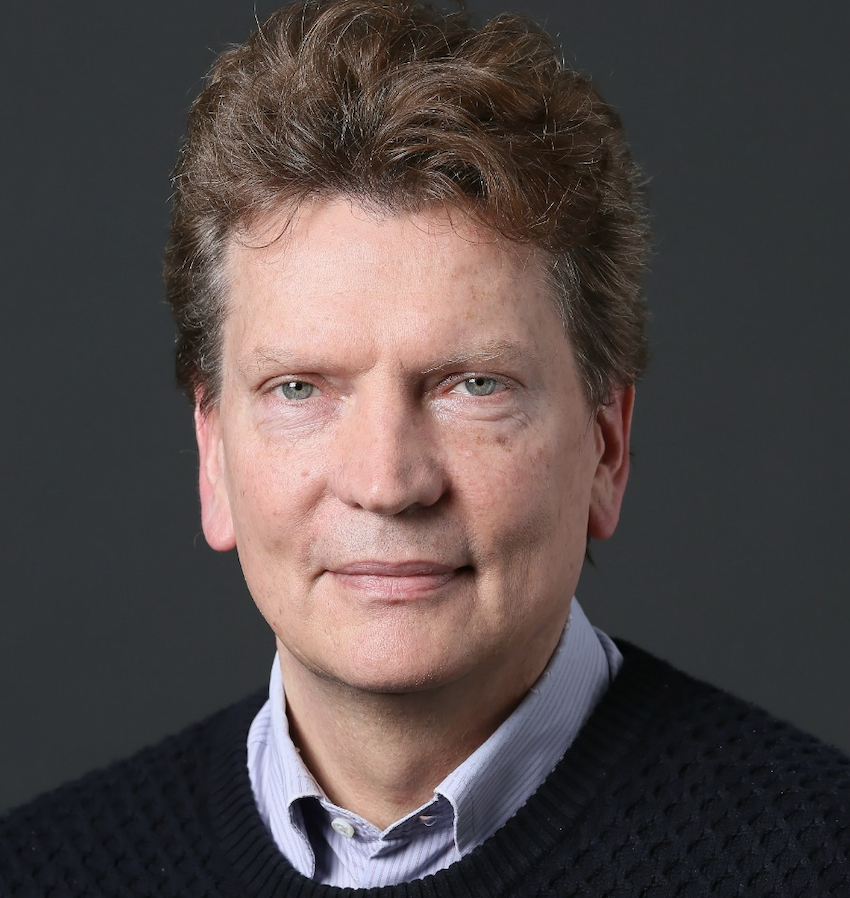

Henry Markram, professor of neuroscience at the Swiss Federal Institute of Technology (EPFL), has pioneered groundbreaking initiatives that have redefined brain research and computational neuroscience, including founding the Brain Mind Institute, the Blue Brain Project, – a Swiss initiative to simulate the brain – and the founder of the Human Brain Project, a Future and Emerging Technologies (FET) Flagship initiative of the European Commission to award €1 billion over 10 years to develop future neuroscience, future medicine and future computing. He is also co-founder and chairman of Frontiers, the open science publisher, Frontiers Research Foundation and the Frontiers Planet Prize. In 2025 he and his wife, fellow neuroscientist Dr. Kamila Markram, launched the Open Brain Institute, a not-for-profit organization with the mission to make the 18-million-line software recipe to build and simulate mammalian digital brains developed in the Blue Brain Project openly available to researchers through AI-powered virtual laboratories.
Markram is also a co-founder of INAIT, a Swiss startup that recently emerged from stealth mode. It has been working, since 2018, on deciphering the neural code, developing a digital brain operating system, and pioneering causal learning to empower digital brains to accumulate cognitive skills. Now, after surpassing technology and product benchmarks and forging strategic partnerships, INAIT is launching inait Adaptive Machines (iAM) across industry verticals, starting with fintech and robotics. Under a partnership agreement, its technology will be distributed through Microsoft and later opened to other Cloud providers. Markram, a scheduled speaker at the DLD conference in Munich on January 17 and at Science House in Davos during the World Economic Forum’s annual meeting Jan. 19-23, recently spoke to The Innovator about how he is leveraging 40 years of brain research to develop brain-based artificial general intelligence (AGI).
Q: How has your research on the brain evolved over time?
HM: I wanted to go into psychiatry, but I realized that to really be able to treat anybody, one would need to be able to fully understand the brain and for that you need to be able to build it. That was 40 years ago, while I was still in South Africa. I dedicated basically the next 20 years to reverse engineering the brain, to study it experimentally, and that meant really diving down into the structure of the brain, basically brain mapping. I moved to Israel to do that, but I eventually realized that you can never get a complete map of the brain because the brain is always changing. It’s different in different species. It’s different in different ages, it’s different in different diseases. Even one map in one state is impossible. A map of thousands of different states is intractable. So, I came up with a plan to build the brain, and I realized that it’s only possible with a back-and-forth process of reverse engineering and forward engineering. You have got to take what you have and see how far you can go to build it and then see if you can fill in all the missing gaps with computational methods. It turns out that by using this approach you probably only need to map a small fraction – 1% – and 99% of it can be predicted. This is because most of the brain, because it’s so well organized, it’s like a massive puzzle. Once you have one piece of the puzzle, a lot of other pieces fall into place. And in that way, we can map the whole brain. So, I started to look for a lab where I can go and build it.
I needed computers that cost tens of millions of dollars. The Swiss government gave me 330 million Swiss francs and the mandate to go find the recipe to build the brain. That took another 20 years. It was called the Blue Brain Project, which was finished at the end of 2024. It involved about 1,100 scientists overall, engineers, informaticians and physicists, chemists, biochemists and computer scientists and we came up with a software ecosystem. We generated over 12 million lines of software which can be used to build the puzzle pieces and stitched together to build the brain.
Q: How will the Blue Brain Project’s research be used going forward?
HM: As Kamila and I really firmly believe that open science can accelerate everything it was natural for us to form a foundation, the Open Brain Institute, and – with EPFL’s permission – are giving the algorithm, the recipe for how to build the brain we worked on in the Blue Brain Project away for free to the rest of the world. It’s not just the recipe, it’s also petabytes of data, all the data we had gathered over 20 years, various tools, how to build a neuron, how to build the ion channel, how to connect neurons. We put that all together in the Open Brain Institute and created virtual laboratories, so people can use these assets to start building. They can build whatever they want. They can build an insect brain. They can build a mammalian brain. They can build even a human brain, if they have the money, but that will cost a lot because it requires massive amounts of computing. We have already built parts of the mouse brain and the rat brain. We’ve got small pieces of the human brain already built, and so researchers can already start with brains that are there, and they can modify them, and they can build more. We want to trigger a kind of collective global effort to build digital brains.
Q: Why build digital brains?
HM: The value of having a digital brain is that it acts like a real brain. Experiments are very revealing because you have full control and access over every neuron and every synapse and every activity that’s going on inside the brain. It gives X-Ray vision. This is very different from when you do an animal experiment on a brain. When you do an animal experiment you need extremely expensive technology to be able to see just one thing that is going on but when you do a simulation you can see that and everything else going on at any level. So now you can start understanding how the brain is putting the information together. The way I think of it is like the Hubble Space Telescope which allows us to look deeper into space. What a digital brain does is allow us to look very deep into a copy of the real brain, giving us a telescopic and microscopic view into the brain that is just impossible with biological experiments. We’re very excited because we believe it’s going to trigger a whole new age of digital brain research which will allow us to delve deep into the brains of any species.
Q: Let’s talk about business applications for your research. Please tell us about your startup INAIT.
HM: The name of the startup is a pun on the word innate. It stands for Inherent Neural Artificial Intelligence Technologies. The reason we named it that is because most of human intelligence is innate. You don’t have to engineer it. The mission of INAIT is to tap into that innate intelligence.
Q: How do you see the brain’s understanding of the real world intersecting with computer intelligence.
HM: The way to think about today’s AI is that it captures knowledge, but it doesn’t understand it. Today’s AI is an observer. It is not participating in the world. The brain is not an observer; it is a participant in the world. This is not possible through correlation. It’s only possible if you do what animals are doing and what we’re all doing, to be born in the world and to grow up in the world, learning cause and effect. We are not learning the patterns of the world. We can leverage the patterns, but the patterns come for free when you know the causal dynamics. To make AI a part of the world you need to build a machine that becomes part of the world. That’s what INAIT set out to do. We raised an initial $65 million from visionary investors. We were in deep stealth for about seven years, and we did it, we solved how the brain learns cause and effect, how it learns dynamics. That is INAIT’s key differentiator. Others solved how to learn correlations, which gives you knowledge AI. We’ve solved how to learn causality, which gives AI understanding and participation in the world.
Q: How will this translate into products?
HM: We have three product ranges. The first is called Future Complete; the second is Cognition Complete, and the third is Behavior Complete. It’s a complete range because we’re completing the AI revolution. The reason we started with future complete is because the foundation of what becomes possible when you can participate causally in data or in a virtual environment or in a physical environment, is that you become an amazing forecaster, which is the foundation of cognition. It’s going to allow companies to basically extend an Excel sheet into the future. Financial services will be the number one application but there are many others. Companies need to see what the future is going to look like. The AI will start understanding the causal dynamics of any business so it can make forecasts and start optimizing to improve efficiency. It’s going to impact every industry sector on the planet. Cognition Complete is the more advanced version. It’s basically causal decision making: AI.
The third product range is Behavior Complete, which enables full scale robotics, robots that really become part of the world, that are lifelike and can interact in a human-like way with humans and deal with dynamic changes in the environment. Let’s imagine you wanted to send a troop of robots to the moon to set up a landing station for space exploration or mine an Asteroid. With today’s AI there is no way these robots can go there independently because they would have to act in the moment and make decisions based on novel information, not on past information. Today they can do some basic tasks, but they’re not going to be able to experiment, explore, innovate or respond to new things or deal with what they discover, which will be completely new. You need continuous learning for that. That’s what we’ve solved. Behavior Complete is going to give you these kinds of robots. It will revolutionize all of robotics. Self-driving cars will become a chip inside almost any smart car. Smart machines will learn how to drive, like we learn how to drive. That’s why our product range is called inait Adaptive Machines (iAMs). If you plug it into a car the AI understands I am a driver. If you plug it into a drone, it understands I am a drone. If you plug it into a humanoid robot, it understands I am a robot.
Q: Are these products already on the market?
HM: They are all in different stages of maturation. Future Complete is ready to go. We are releasing it this year. Starting this month we’re working with major energy providers, banks and manufacturers to test it for them in their environments. By June we will release the first version of Cognition Complete and early next year, we will be releasing Behavior Complete for full-scale robotics. So, the products are in very advanced stages of maturation. We are ready to work with any business to help them do process optimization, supply chain management, etc. Microsoft is going to help us bring this technology to all sectors of business, all areas of society, through many different channels. We are making digital brains available in Azure. After that, we will go multi-Cloud and we will work with everybody, but we really value our partnership with Microsoft. We think that they’re the right partner to build a very trusted environment that is controllable and transparent.
Q: Why is this form of AI more controllable and transparent?
HM: This is the most transparent AI you can get because it’s causal. When you have correlations, you have a black box. There are so many correlations you don’t really know what is causing what, but when you have causal you can trace the chain of causality, and you can be fully accountable for why a decision is being made and why you’re taking an action. Causality will give you Explainable AI. In terms of controllability, what we do is we can give AI a domain of responsibility, let’s say, a supply chain. We can set it up to have the ability to learn the supply chain. Every day, every second, it’s going to improve on being a supply chain manager but that will be its domain. It can’t cross its domain of responsibility. It’s not going to have the independence to be able to jump into other domains. In the future, if you want to send a robot to the moon or to mine asteroids or to do space exploration, you will need to open that domain to much broader categories of actions and activities. But for all intents and purposes, for everything that society and businesses need today, you can provide that within controllable domains of responsibilities.
Q: What do you want readers to take away from this interview?
HM: The main message is that we have reached a halfway mark In the AI revolution. I think it’ll keep growing and penetrating the world and impacting the world in incredible ways, because it’s bringing knowledge to anybody and everyone and every enterprise in the world, and that’s going to continue. But it does not have causality. It does not have continuous learning. It does not have the ability to act forward on new information. That is what’s coming. We are moving from the knowledge AI revolution to the understanding AI revolution. That understanding is going to give us true intelligence that is natural, in the same way that animals and humans have intelligence, and it is going to be explainable, controllable, transparent and have very lifelike capabilities with causal reasoning. Every single business can benefit from this from the smallest retailer to factories, agriculture, mining and drug design. We are introducing an AI that understands the world. It sounds like science fiction but it’s here.
This article is content that would normally only be available to subscribers. Become a subscriber to see what you have been missing