
Cruise ships are known for their decadent buffets. In a ship kitchen where thousands of dishes are orchestrated each day, even small gains in precision – such as how to cut melon to reduce the trimmings – can transform performance.
In just six months, the Carnival Cruise Line’s use of an AI platform purpose-built to deliver reliable real-time kitchen intelligence at sea, overcoming the movement and constraints of a shipboard kitchen, has helped culinary teams align prep to per-person demand 17% more accurately, accelerating decision-making across thousands of daily meals, according to Orbisk, the Dutch scale-up that fine-tuned the technology for the cruise line.
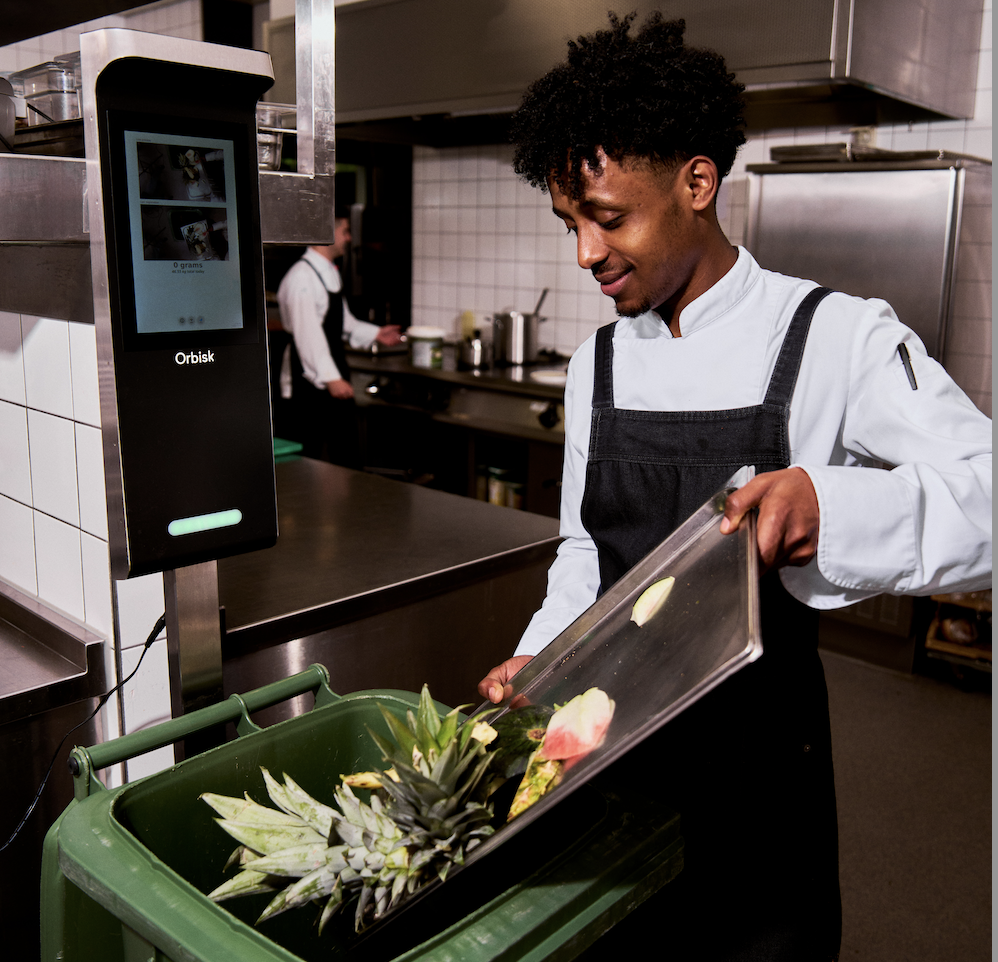
Orbisk’s fully automated system, called Orbi, acts as a command center for the kitchen, using advanced image recognition to capture what’s prepared and served, as well as what is thrown away, with no manual input required.(see the photo). Workers hold food waste under the Orbi’s sensor. It snaps a photo automatically. No buttons. No waiting. Then they drop it into the garbage bin as they normally would. The Orbi logs everything automatically with no workflow changes. Chefs and managers get instantly actionable insights through a personalized dashboard, making it easier to plan production and fine-tune inventory control.
Orbisk is working with cruise lines, hotel chains, hospitals, corporate catering and military bases in 45 countries to use AI to reduce the estimated 200 million kilos of annual food waste from industrial kitchens.
It is an example of how recent progress in automation – driven by advances in AI, machine learning and computer vision – can help combat food waste. At the same time, the combination of AI and robotics is making it easier to separate food from other waste streams, enabling large-scale recovery for composting, biogas production or upcycling. By scaling up diversion and reuse, food waste automation technologies reduce landfill emissions, lower demand for newly sourced agricultural inputs and strengthen circular food systems, according to a recent report by the World Economic Forum prepared in partnership with Frontiers, the open science publisher. It is one of ten emerging technology solutions for planetary health identified by the report.
Food waste decomposing in landfills emits greenhouse gases and contaminates soil and water with pathogens, says report co-author María Pilar Bernal, a Research Professor at Spain’s Centro de Edafología y Biología Aplicada del Segura, Consejo Superior de Investigaciones Científicas Murcia. “The waste of food is not sustainable,” she says. “We must take action.”
With mounting evidence that we have already exceeded Earth’s “safe operating space” and breached seven of the nine planetary boundaries there is an urgent need for solutions that mitigate greenhouse gas emissions, maintain biosphere integrity, enable resource efficiency and even repair Earth systems. The report illustrates the role technology can play in accelerating progress.
Economic and Regulatory Incentives
When it comes to food waste there is still a long way to go. Orbisk and its competitors worldwide are currently supplying technology to reduce waste to somewhere between 5,000 and 10,000 of the 10.5 million restaurants globally, estimates Olaf van der Veen, Orbisk’s Co-founder and Chief Impact & Innovation Officer. “That means that all of us together have a market penetration of .1% so there is plenty to do,” he says.
The average restaurant wastes 20,000 kilos of edible food per year, he says. Orbisk promises its technology can result in up to 70% less food waste. “The industry has almost invisible margins so we tell them that they can earn the equivalent of their full profit margin by reducing their waste levels,” says van der Veen, with no staff training necessary.
Orbisk cites the example of Novotel Warszawa Centrum which slashed its food waste per hotel guest by 69% using its technology. Orbisk’s automated cameras and scales captured every discard. AI recognized each item, analyzed it by meal period and prep state, and pushed the data into the dashboard. The team could see waste patterns including CO2 impact from discarded items; cost impact tied to ingredients and purchasing and image-driven tracking of most wasted products.
Orbisk’s system then gave specific advice about how to reduce the waste. So why isn’t every restaurant or caterer taking advantage of advances in technology to reduce waste? “Here is a funny stat: about 90% of restaurants and businesses think they are wasting less than the average,” says van der Veen. “They acknowledge that food waste is a big problem but think they have it under control. About 99% of the time that is simply not true.”
One of the complicating factors is the lack of standardization in the way businesses measure waste. Right now, one hotel measures waste by weight, another by covers, and a third by percentage of revenue.
That is expected to soon change, though. A new standard, ISO 20001, sets definitions, consistent metrics, and shared best practices covering storage, transportation, processing, and packaging, with the aim of having breakfast buffet waste, prep station trimmings, and plate returns measured the same way across businesses. This upcoming standard will give the food industry its first global, certifiable framework for preventing and reducing food loss and waste across every stage of the supply chain.
As governments set reduction targets companies are facing pressure to show verified progress. In the U.S., food waste regulations are already shaping business practices. California’s SB 1383 requires a 75% reduction in organics waste and mandates the donation of surplus food. New York City requires organic waste separation for businesses above certain thresholds, and Massachusetts bans commercial disposal of organic waste for operations generating more than half a ton per week.
In Europe the European Commission’s s 2025 amendment of the Waste Framework Directive introduced binding food waste reduction targets for member states to achieve by 2030. Member States are required to take the necessary and appropriate measures to reduce food waste by 10%, in processing and manufacturing, and by 30% (per capita), jointly at retail and consumption (restaurants, food services and households).
Turning Scraps Into Resources
AI and other emerging technologies are also helping municipal waste facilities do a better job handling food waste. Once limited to large recycling plants and agricultural processors, advances in sensor design and energy efficiency have made the technology more compact and affordable, allowing broader deployment.
In Seoul, for example, automation supports a citywide food waste program that diverts over 95% of food scraps from landfill or incineration. Meanwhile, the Netherlands are testing AI-driven sorting lines to separate food from packaging at centralized composting hubs.
Growing demand for upcycled products – including animal feed, compost blends, bioplastics and even food ingredients – is increasing the economic viability of these systems, says the Forum report. A recent estimate valued the global market for upcycled food products at over $50 billion, with strong growth expected over the next decade.
Closing A Critical Gap
The report says automated sorting systems are poised to transform waste management industries, with wide-ranging environmental, economic and societal impact, says the Forum report:
- Environmentally, these systems reduce methane emissions from landfills and support nutrient recycling through composting and anaerobic digestion, helping to protect planetary boundaries related to climate change and biogeochemical flows.
- Economically, automation could open new markets for upcycled food waste products such as animal feed, compost blends and bioplastics – while creating new roles in sensor maintenance, robotics integration and circular product development. (However, the Forum report warns that high capital costs may limit adoption in low-income regions or small-scale facilities, slowing widespread impact).
- Societally, expanded recovery infrastructure could reduce environmental burdens in low-income communities disproportionately affected by landfills, while strengthening city-level efforts to meet zero-waste and climate targets. In doing so, food waste automation could help close a critical gap between growing waste volumes and limited capacity for sustainable disposal, concludes the report.
One day consumers, too, might individually play a more important role in reducing food waste. It is a problem that society as a whole needs to solve, says Pilar Bernal, the report’s co-author. “Consumers need to understand what is going on with their waste and the implication of not doing anything about it,” she says.
A system like Orbisk’s works for industrial kitchens because they “are running a process and preparing the same menu, so by understanding the waste of today you can make better decisions tomorrow,” says van der Veen. Consumer households need a different approach. Eventually AI will be able to tell households what they have in their fridge and how to make it into a meal, so nothing goes to waste. “I do believe this will become an option,” he says. At present, though, companies like Orbisk have enough on their plates convincing business to use tech to fight food waste.