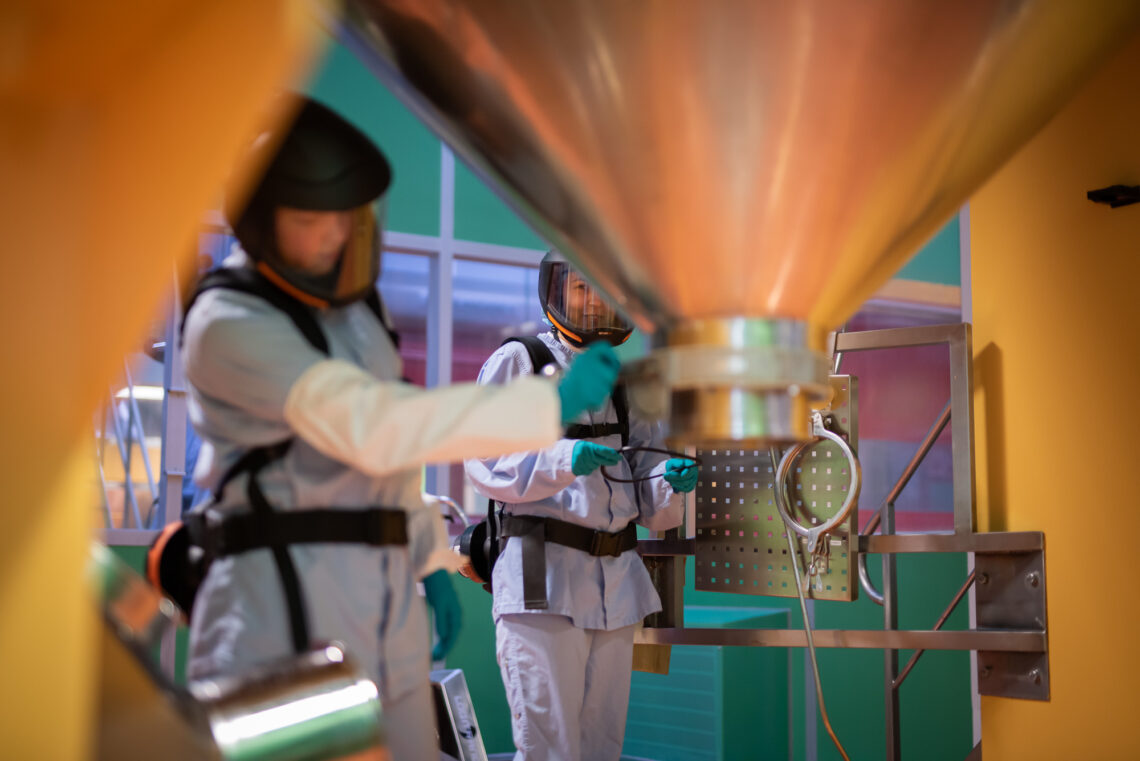

In a research park in Gothenburg, Sweden, a smart material is being developed that eliminates the need to use harmful chemicals, plastics and large amounts of waste to purify biological drugs, such as antibodies. Early outcomes suggest the technology could offer a more flexible and dynamic purification method, with significant potential to increase the efficiency and reduce the environmental footprint of biopharmaceutical manufacturing.
The technology was not invented by AstraZeneca, but by Nyctea Technologies, a Swedish startup spun out of Chalmers University, that has been quietly working away in the pharma giant’s facilities since 2023. It is one of the dozens of smaller companies that have taken up residence on the same campus, with open access to AstraZeneca’s infrastructure, its expertise and, crucially, its problems. (See The Innovator’s separate story about Nyctea.)
That culture of proximity and openness — what AstraZeneca calls ‘dare-to-share’ — has been the operating principle of BioVentureHub since it launched in 2015. The program, which was co-funded by the Swedish government for 10 years and is now fully financed by AstraZeneca, is based on an open innovation model, which involves co-locating startups and SMEs with the global pharma company’s R&D facility in Gothenburg. The model takes a no-strings-attached approach, providing access to industry expertise and infrastructure without taking IP or limiting young companies from working with its competitors. Since its launch, the BioVentureHub has successfully attracted over 70 national and international companies.
The initial focus was to catalyze innovation across biotech, diagnostics, medtech and pharmaceutical companies by connecting them to digital companies to better envision the future of healthcare. AstraZeneca has since expanded the mandate to include sustainability.
Now it is widening the net further with a new cross-industry collaboration with Scania, a Swedish manufacturer of heavy trucks, buses and engines, and RISE (Research Institutes of Sweden), Sweden’s state-owned research institute, that aims to tackle one of the hardest challenges in the green transition: how to scale sustainable solutions across complex industrial value chains. The initiative, called SustainTech, brings together large industry players, research capabilities and startups to accelerate innovation from early-stage ideas to real-world deployment.
The platform builds on BioVentureHub’s open innovation approach, which enables startups and SMEs to gain access to industrial environments, expertise and infrastructure to develop and validate their technologies. By combining pharmaceutical R&D, heavy industry scale and applied research, SustainTech is designed to address sustainability challenges that no single company can solve alone — such as decarbonization, industrial sustainability transformation and Scope 3 emissions across supply chains.
The plan is to create a shared platform to develop, test and scale solutions in areas such as green chemistry, circularity, carbon capture and fossil-free transport.
The initiative will offer small and medium-sized enterprises (SMEs) access to industrial expertise, infrastructure (including manufacturing capabilities in Södertälje), and relevant testbeds and competence from RISE. The initiative envisions a public-private partnership model, with a total of 95 million SEK (€8.77 million) over 5 years: 15 million SEK in the first year and 20 million SEK per year for the next four.
The collaboration will support innovation across technology readiness levels (TRL), primarily in the industrial incubation and scale-up (TRL 5–7) phase. Piloting and implementation of mature opportunities (TRL 8–9) are case-specific and will be driven by individual industry partners.
“We are trying to position the SustainTech initiative as a concrete example of how a public-private partnership, originating at a national level, can offer a powerful blueprint for broader EU engagement,” says Magnus Björsne, BioVentureHub’s CEO.
An Unlikely Pairing
On the surface, a pharmaceutical company and a heavy truck manufacturer make for an odd couple. AstraZeneca’s core challenge is cleaning up what its factories emit and leave behind — PFAS contamination, solvent waste and the energy costs of drug synthesis. It wants initial focus areas to include:
- Green Chemistry and Biocatalysis: Developing processes that minimize waste and hazardous substances and are more energy- and resource-efficient in pharmaceutical manufacturing. PFAS, often referred to as forever chemicals, is a key target area.
- Waste Minimization & Valorization: Implementing effective waste management and recycling strategies, such as solvent recycling and appropriate disposal of pharmaceutical products.
- Carbon Capture and Utilization (CCU): Developing technologies to capture CO₂ emissions from manufacturing and utilize them as raw materials for sustainable materials.
- Digital/Data/AI solutions for faster and safer drug development, and deep tech enabling pharma R&D.
Scania wants to focus on opportunities and challenges across industrial systems, supply chains, commercial systems and beyond, says Harsha Raju, Scania’s project lead for SustainTech. “We were the first in the industry to adopt science-based targets (SBT) in 2020. We want not only to hold ourselves accountable but also to set an example and inspire change across our sector.”
Scania was intrigued by the BioVentureHub model of engaging a wide variety of players in an ecosystem, he says. “We wanted to learn from it, and the best way of doing that was to approach sustainability in manufacturing together.”
What the two companies share is the recognition that neither problem yields to a single technical fix — and that meaningful solutions are almost always hiding in smaller organizations that lack the capital and facilities to prove them at scale.
The issue is that young companies often develop their solutions in isolation and do not have any contact with industry until they go to market. The SustainTech initiative wants to connect with young companies at an early stage and guide them to ensure they are working on real industry sustainability problems.
Industry will benefit from faster access to innovation and valuable external competence, and SMEs will benefit from industrial support and pathways to scale, Raju says. “We are not aiming to own the solutions. The companies we work with are free to develop and apply them more broadly, so the impact can extend beyond individual partners to benefit the environment.”
RISE To The Occasion
RISE has a crucial de-risking role to play in the partnership. It can conduct early-stage verification of concepts presented by startups or SMEs and use its 130 testbeds and research infrastructures to validate new technologies intended for large-scale industry, says Eilert Johansson, a RISE business development executive. “When we start to see things being implemented in real production, or with one of the suppliers, that is where the innovation really flows and can lead to real change — not just on one company’s environmental impact but on the whole supply chain,” he says.
Joining The Ranks Of Corporate Venture Squads
The SustainTech collaboration is part of an emerging practice in which groups of corporations work collectively with startups to move beyond isolated pilots, share startup-scouting capabilities, benefit from network effects, and accelerate knowledge sharing among corporate leaders, policymakers and innovation practitioners. They are called corporate venturing squads.
IESE Business School research has identified 671 organisations across 116 corporate venturing squads worldwide, says Josemaria Siota, co-author of an IESE Business School study on the topic. This trend responds to a growing constraint in industrial transformation. While many technologies relevant to climate action, supply-chain resilience and industrial productivity are technically proven, they often stall at the pilot stage, he says. This is even more of an issue in developing and emerging markets.
A corporate venturing squad model close to the Swedish SustainTech initiative is one created by the United Nations Industrial Development Organization (UNIDO), says Siota, the executive director of IESE’s Entrepreneurship and Innovation Center and an advisory board member for UNIDO’s ScaleX program. UNIDO is building on emerging corporate practices and extending them into a broader, public-purpose model aligned with development objectives. Participating firms commit upfront to acting as early users of deployable solutions within their own operations. Deployment takes place in live industrial environments, generating real demand signals and operational evidence, while structured policy and regulatory experimentation enable governments to learn alongside market actors. UNIDO is now exploring how the same venture client logic can be adapted to other stakeholders, including cities and SME clusters, where fragmented demand and risk similarly inhibit adoption at scale.
The European Opportunity
Like UNIDO, SustainTech is global in scope, but it could end up being particularly advantageous for Europe, says BioVentureHub’s Björsne.
“We recognize that Europe faces significant challenges, and there is a need for a transformational business plan to accelerate decarbonization, reindustrialization and innovation,” says Björsne. “Our innovation model offers a practical and proven mechanism to directly address these challenges and contribute to Europe’s strategic goals.” He says he believes SustainTech aligns well with EU initiatives like the Clean Industrial Deal and the Strategic Technologies for Europe Platform (STEP).
However, Björsne points out that industrial policy is often hindered by fragmented national efforts and financing. “Our public-private partnership model, involving industry leaders and research institutions like RISE, demonstrates a way to overcome this by fostering cross-sectoral collaboration and pooling expertise,” he says. “We have proven that this model can attract and develop innovative companies and could as such provide a means to help the EU increase its focus on breakthrough innovation.”
He points out that a significant portion of European VC money goes into green tech. “The question is: how do we position Europe to benefit from those innovations?” he asks. SustainTech provides a platform to facilitate the growth of innovative companies by offering access to industrial expertise and infrastructure, helping to retain innovation within Europe, Björsne argues. “The initiative is currently anchored in Sweden, benefiting from Swedish government support. However, we strongly believe that this successful, albeit regionally focused, model has the potential for significantly greater impact if scaled up through EU-level engagement and financing. I believe that turning a successful national model into a pan-European platform would be a powerful step towards strengthening European competitiveness and achieving our shared sustainability goals.”
The SustainTech initiative is just getting started. “Let’s see what we can do,” says Scania’s Raju. “We want the SMEs with the smartest brains to work with us on sustainability and create an ecosystem and environment that will attract them to stay here to scale and grow. The message is: come and innovate with us.”
This article is content that would normally only be available to subscribers. Become a subscriber to see what you have been missing