
Estonia, which built one of the world’s most advanced digital states, is now urging other governments to prepare for the next shift: AI agents acting on behalf of citizens, companies, and officials. That message was front and center at the Tallinn Digital Summit (TDS), where some 1,300 delegates from more than 80 countries gathered November 5-6.
A big focus of the conference was the agentic state: a comprehensive transformation of public administration that enables AI agents to handle the public’s requests while human officials focus on strategic direction, political accountability, and decisions requiring judgment.
A vision paper adopted at last year’s TDS describes the arrival of agentic AI as “the most significant disruption to how governments work since the rise of the modern state.”
Estonia is making the leap, but it is not stopping at making public services more seamless for its citizens. Building on its pioneering e-Residency program, the country is developing what it says would be the world’s first digital framework for letting AI agents act on behalf of people and companies under clear, accountable rules.
Ministers from more than 10 countries attended the conference, including France, the United Kingdom, Finland, Ireland, Malta, Portugal, Poland, the Netherlands, and Austria. Hundreds of bilateral meetings took place during the summit at the ministerial, business, and expert levels. Side events included the 2026 Digital Nations Ministerial Summit, which focused on how governments can navigate the adoption of AI while reinforcing democratic values and public trust.
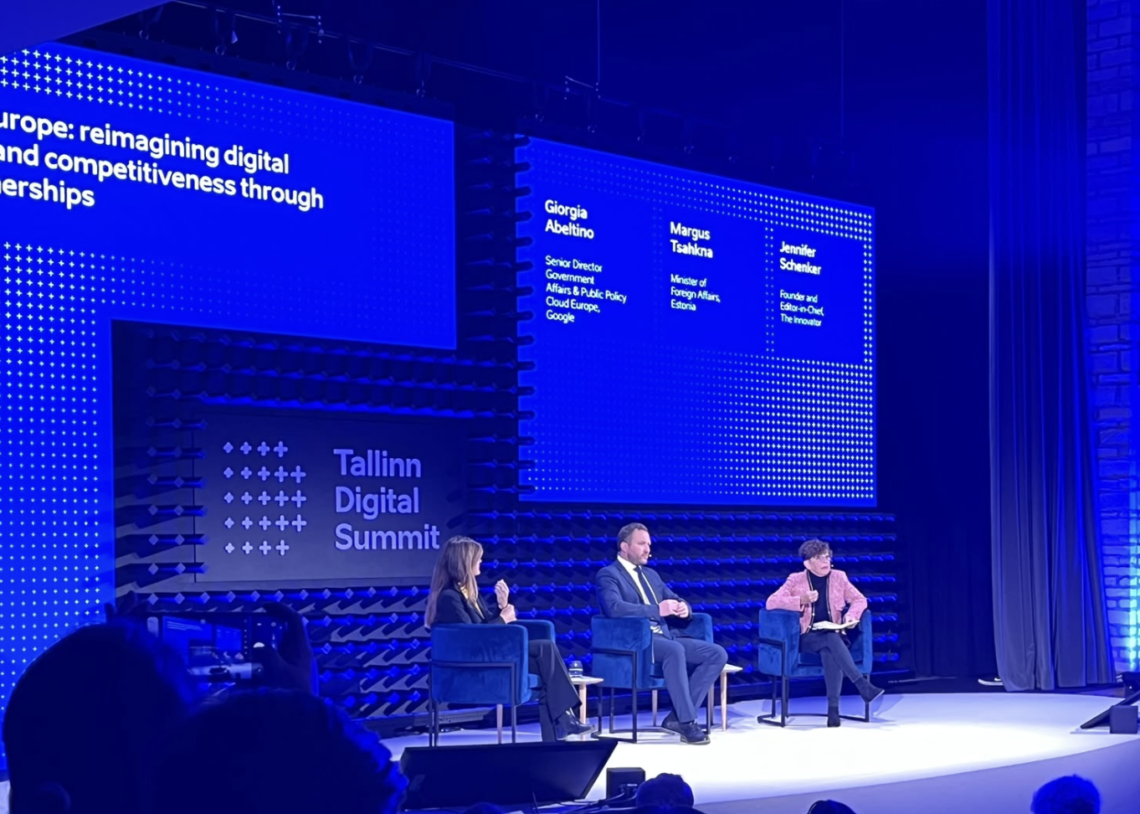
The Innovator’s editor-in-chief moderated two panels at the summit, including one with Estonian Foreign Minister Margus Tsahkna and Giorgia Abeltino, head of government affairs and public policy for Google Cloud EMEA (see photo). Read on for the key takeaways.
The Rise Of The Agentic State
The vision paper presented at last year’s TDS laid out the first comprehensive framework for how AI agents will transform the core functions of government — from public service design to policymaking, crisis response, and procurement — and addressed the enablers needed, including agent governance and cybersecurity.
One year on, the 2026 conference examined where things stand. More than 750 AI initiatives have already been launched in 75 countries. Governments have good reason to get on board. Attendees were told that some are already reporting “agentic flooding,” as citizens’ and businesses’ own AI agents begin to overwhelm public service channels built for humans.
Governments worldwide have consistently lagged in technology adoption, creating efficiency gaps and mounting citizen frustration. “This pattern has left public institutions operating with outdated tools while citizens experience government as slower and less responsive than virtually every other service in their lives,” says the 2025 vision paper. It says agentic AI, which industry leaders are adopting at an unprecedented pace, stands to widen this gap further unless governments up their game.
Estonia is helping pioneer the design of AI agents for public services and hopes to serve as a model for how to mitigate risks, said speaker Luukas Ilves, co-founder of the Agentic State initiative; AI adviser to Ukraine’s minister of digital transformation and to the Government Office of Estonia; and non-resident fellow at the International Centre for Defence and Security (ICDS). ICDS, an Estonian defense, security, and foreign policy think tank, organizes TDS together with Estonia’s Government Office, Ministry of Justice and Digital Affairs, Ministry of Foreign Affairs, and Ministry of Economic Affairs and Communications.
Because giving an agent full access to a person’s identity could expose far more information and authority than the agent needs, Estonia has proposed an agent code: a separate digital identity linked to the person who authorizes the agent. The agent code would not make an AI a citizen, a company, or a legal person; instead, it would make delegated authority visible, allowing permissions to be limited, monitored, and revoked. The person or organization granting the authority would remain responsible.
The economic case for agent codes follows the logic of Estonia’s e-Residency program, which gives non-Estonians a government-issued digital identity that lets them use the country’s public e-services online. That gives foreign nationals who want to launch and run an EU-based company remotely access to services such as company formation, banking, payment processing, and taxation.
Estonia did not create a market by selling digital identities as an end in themselves. It used identity to connect entrepreneurs worldwide to a functioning digital business environment.
AI is now lowering the cost of starting and running a company. People who previously lacked the skills, capital, or team to start a business may be able to use agents to manage parts of its operations. Existing companies are also beginning to use multiple agents for reporting, contracts, customer service, finance, and compliance. Those companies will need a place where their agents can operate under clear rules. Estonia says its opportunity is to make its digital state usable by agents in a controlled way, while creating new activity for local service providers and attracting more AI-era companies to the country.
The proposed system is not a finished product. Legal, business, and technical teams are still working on registration, authentication, permissions, audit trails, and revocation.
A separate project led by Estonia’s Information System Authority, Reason Reserve/Aruait, is examining related questions for autonomous AI agents in the public sector. It is developing an Identity 2.0 framework for machines, a trust registry for public AI assistants, and interoperability standards. Technical development and testing are ongoing, with a pilot of selected use cases and partners scheduled to launch in December.
Ukraine is also racing ahead. Since 2019, it has carried out one of the most ambitious public-sector digital transformations in the world. The primary enabler is the Diia platform, used by 23 million citizens. Ukraine now aims to become an agentic state. It is publicly beta testing four AI agent applications covering certificates of residence, traffic fine payments, income certificates, and credit history, said TDS speaker Oleh Dubno, chief operating officer of Ukraine’s AI Centre of Excellence, which represents the country’s Ministry of Digital Transformation.
Other governments working on agentic AI programs include:
- United Arab Emirates: The UAE has announced a government framework to deploy agentic AI across 50% of government sectors and operations within two years.
- Europe: The European Commission’s AI@EC platform and national initiatives in Poland, the U.K., Germany, France, and Greece are bringing AI into public administration, with a focus on open models, locally controlled infrastructure, and synthetic datasets. The projects cover healthcare imaging, employment services, multilingual document analysis, and sovereign collaborative workspaces, and are being rolled out with U.S. chipmaker Nvidia and its partners.
- United States: The Trump administration launched America.gov on September 29. The AI-powered portal lets people ask questions in plain language instead of navigating thousands of separate federal websites, and President Donald Trump signed an executive order directing agencies to integrate their sites with it. For now, the portal points users to official information rather than completing tasks on their behalf. States are moving further with agents themselves, though mostly in pilots. Under Utah’s regulatory sandbox, an AI agent developed by Doctronic renews prescriptions for patients with chronic conditions, an experiment the state’s medical board wants halted. Virginia used thousands of AI agents to comb its regulatory code for outdated, redundant, and contradictory rules. Alaska, Tennessee, and the Texas Department of Transportation are exploring agentic tools, according to a report by the National Association of State Chief Information Officers, which says such projects remain largely experimental.
For more on global government initiatives, see the Agentic State observatory.
AI And The New Economics Of Competitiveness
Estonian Prime Minister Kristen Michal opened the summit with a call to action. The AI sector is dominated by the U.S. and China, he said. “The rest of the world has been asleep at the wheel. We all need to wake up.”
The future of Europe’s economy and society depends on Europe being a builder of AI, not just a buyer, Michal said. “Europe paid a price for its dependence on Russian energy. Let’s not make the same mistake with AI.”
“Estonia has never been afraid to embrace new tech,” Michal said, “but we can’t build our future alone. Europe has an important role to play. The choice is ours to make.”
A panel titled “AI and the New Economics of Competitiveness,” moderated by The Innovator’s editor-in-chief, explored how competitiveness, once measured in factories and patents, increasingly comes from companies building agents, the networks that carry them, and the software that rewires how firms operate. But that momentum doesn’t compound into national advantage on its own. So how should it be directed? Who does what, who gets the credit — and can democracies actually capture the value?
Panelist Thomas Madsen-Mygdal, an entrepreneur and investor, estimated that Europe’s failure to build digital industries has cost it more than €500 billion and 10 million jobs. He leads Rebuild, a Denmark-registered NGO that aims to help Europe build its own AI-powered social platforms and regain its sovereignty and confidence.
Cecilia Bonefeld-Dahl, director general of DigitalEurope, a Brussels-based trade association that represents the digital technology industry, said Europe isn’t losing the AI race. It’s running the wrong race.
The world’s best athletes never bad-mouth the judges or the winners, she said. They focus on learning from the match and on what it takes to win, not on limiting others’ future wins by constantly changing the rules and adding new ones.
To succeed in the age of AI, she urged Europeans to adopt a winning mindset: less regulation, deeper capital markets, more EU Inc. and scale-up funds, more common procurement, and a focus on the areas where Europe already holds winning positions, such as connectivity, energy tech, water tech, and drone tech.
Asked what single metric should be used five years from now to judge whether Europe has captured the agentic era, she said it should be whether 90% of the world’s CEOs, including European CEOs, say Europe is the best place in the world to scale cutting-edge technologies.
Reimagining Digital Sovereignty And Competitiveness Through Trusted Partnerships
The U.S. and China alone capture around 65% of aggregate global AI investment, according to the World Economic Forum. Their outsized presence in every element of the AI value chain reflects a full-stack approach that few economies can match, given the scale of investment needed. Faced with this reality, many leaders are now asking what steps they should take to stay in control of their country’s future. The instinctive response is often to try to do everything at home — to build fully sovereign AI and treat reliance on partners as a threat, according to a January report from the Tony Blair Institute for Global Change. It argues that while this instinct is understandable, it is wrong. “Full self-sufficiency is too expensive, too slow and, for most countries, simply impossible,” the report says. “More importantly, it misrepresents what sovereignty really means in a digital, global, and interconnected world.”
Sovereignty in the age of AI is a hybrid construct, the report argues. “It is a continuum of agency defined by a state’s ability to make deliberate, future-oriented choices about how AI is integrated, governed, and used in ways that protect public interests, create value, build domestic ecosystems, and preserve fallback capacity if external access is disrupted.”
Tsahkna made a similar case. He said that for Estonia, digital sovereignty means choice, capabilities, and control — not isolation.
But can Europe rely on U.S. AI without giving up control? That was the question at the heart of the panel with Tsahkna and Google’s Abeltino.
The U.S. CLOUD Act (Clarifying Lawful Overseas Use of Data Act), passed in 2018, allows U.S. authorities to compel U.S.-based technology companies to hand over data in their possession, custody, or control, even if that data is stored on servers outside the United States. Europeans worry that this puts their citizens’ and companies’ data within reach of U.S. law enforcement whenever it is held by a U.S. provider, even in a European data center, bypassing European courts and potentially conflicting with the EU’s General Data Protection Regulation.
Abeltino explained how Google is working to build trust in Europe. To address such concerns, the company has formed S3NS, a joint venture with French defense and technology group Thales, which she said is engineered so that neither Google nor the U.S. government can access European citizens’ data or switch off access.
But bigger issues loom, Tsahkna noted, including the impact foreign-made frontier models could have on European societies and on each nation’s culture. The question remains: Is technical sovereignty enough if the models themselves shape European values?
Shaping The Rules And Partnerships For The AI Era
The conference emphasized how public-private partnerships and trusted international cooperation remain essential in two key areas: defense and AI governance.
Sessions covered countering hybrid and cyber threats; protecting critical infrastructure; new technologies for defense, including lessons from Ukraine’s wartime digital transformation; and unlocking the full potential of dual-use technologies.
The risks posed by AI — and how to make regulation fit for purpose — were also hot topics. “The goal of frontier AI companies is to figure out the fastest way to get to artificial general intelligence,” said one speaker. “If we let that happen in the wild, then all bets are off.”
If governments want AI to be used for good, both technical and regulatory guardrails must be put in place, panelists agreed.
[For more on securing our digital future, see The Innovator’s interview with Estonia’s Dan Bogdanov, who leads Cybernetica’s Information Security Research Institute, which develops technologies that help governments and industry secure their data, identities, and assets.]Ensuring that people stay in charge should be a goal, Michal said in his opening speech. That point was neatly illustrated by the conference’s opening segment, which featured a dance troupe whose members unraveled skeins of yarn as they moved until they were all intertwined. The dance was accompanied by the narration of an Estonian folk tale that ends with a message relevant to sovereignty, security, and success in the AI age, and one that echoes the thinking behind Estonia’s agent codes, which keep a human accountable for every agent: “Keep one thread in your own hand and never, ever disconnect.”