
On February 28 U.S. and Israeli strikes on Iran effectively sealed the Strait of Hormuz — and with it, the fate of the world’s spring planting season. Within days, fertilizer tankers sat stranded in the Persian Gulf, war-risk insurance premiums had jumped tenfold, and global urea prices were on their way to an 80% surge. For farmers from Iowa to India, a distant military conflict had become an intimate and very costly problem.
The strait — a 21-mile-wide channel between Iran and Oman — is not just the world’s most critical oil chokepoint. It is also the artery through which flows roughly a third of the world’s seaborne fertilizer trade. The Persian Gulf’s combination of abundant, cheap natural gas and world-class production capacity has made the region the undisputed engine of global nitrogen and phosphate fertilizer supply. Saudi Arabia, Qatar, Iran, the UAE, Kuwait, Bahrain and Iraq collectively account for nearly half of global urea exports and around 30% of global ammonia exports.
There is no detour. Unlike oil, which can be rerouted in part through pipeline corridors and overland routes, fertilizer shipped from the Gulf has only one way out to sea. Companies like QAFCO in Qatar and GLOBEN in the UAE — facilities that sit at the heart of global supply chains — suddenly found themselves unable to produce and ship at anything close to normal capacity. When that exit closed, the world’s food supply chain began to fray.
A Crisis Measured In Tons – And In Meals
The numbers are stark. According to consultancy CRU Group, between 55% and 60% of Middle Eastern urea production may have been halted since the start of the conflict. Global urea prices climbed above $850 per metric tonne in April 2026 — the highest level since April 2022 and nearly double their late-February levels. In the United States, anhydrous ammonia in Illinois surged from around $828 per tonne before the conflict to over $1,123 per tonne by mid-April, according to USDA data.
For American corn farmers, the disruption added up to $35 per acre in additional fertilizer costs.
The consequences fall heaviest on the world’s poorest farmers. The FAO’s Chief Economist Máximo Torero warned that countries with fragile food security — particularly in sub-Saharan Africa and South Asia — face the most acute risks. These nations typically hold no strategic fertilizer reserves, have little financial capacity to absorb price shocks, and are already operating on the thinnest of margins. A prolonged disruption could trigger yield shortfalls reminiscent of Sri Lanka’s 2021 fertilizer crisis, with the potential to destabilize governments as well as harvests.
India, the world’s largest importer of urea and heavily dependent on Middle Eastern ammonia, has been particularly exposed.
Why You Can’t Just Turn Up The Tap
The obvious question is: why can’t producers outside the Gulf simply ramp up output to fill the gap? The answer is that it is easier said than done. That is where Swiss scale-up Akselos — a World Economic Forum Technology Pioneer — comes in. It is using AI to help the fragile, interconnected fertilizer supply chain respond.
The world has somewhere between 300 and 500 fertilizer plants, most of which take natural gas and convert it into ammonia or urea. The process sounds straightforward, but the industrial reality is anything but. A fertilizer plant is essentially a simplified version of the kind of gas-to-liquids chemistry that Shell has perfected at its vast Pearl GTL facility in Qatar — a process of molecular transformation carried out at extremes of temperature and pressure, on steel structures that are pushed relentlessly toward their physical limits.
Akselos CEO Thomas Leurent spent more than a decade building physics-based AI digital twin technology for exactly these kinds of industrial assets. He explains why AI is needed. Running a fertilizer facility harder means running it closer to its structural limits. Without a precise, real-time understanding of where those limits lie, the only responsible option is to proceed cautiously — even when global food security is screaming for speed.
At the heart of any ammonia plant is a component called a steam methane reformer, or SMR — a structure as large as a building, through which natural gas is transformed into hydrogen, which is then combined with nitrogen to produce ammonia. The SMR is the most stressed piece of equipment in the plant, and the key to understanding both the limits of production and the risks of pushing beyond them.
“If you run the SMR hotter, the catalyst reacts better and you get more output,” Leurent explains. “But if you go too far, you get what they call creep. Creep is when the metal starts behaving like a liquid over a long time. Things start to get out of shape, and then you have cracks.” At the point of excessive creep, operators face no good options: a major shutdown and partial replacement of the asset — weeks of lost production at precisely the moment the world needs more.
The danger is not only slow and structural. When an SMR is started up, the temperature differential between its hundreds of individual pipes must be carefully controlled. If the delta rises too high, the unit can catch fire. “You still have to shut it down,” Leurent says, which means a week of unplanned downtime.
AI That Sees Through The Steel
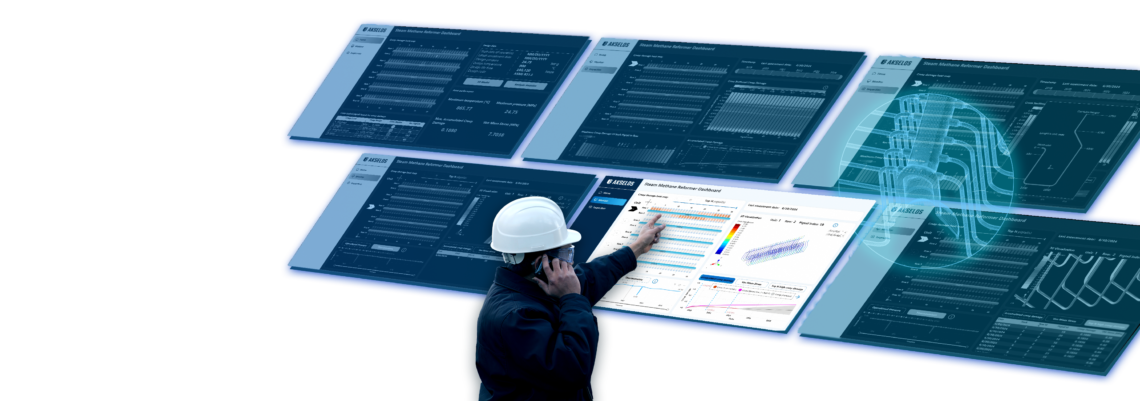
Founded in 2012 as a spin-out from MIT, Akselos has developed what it calls structural performance management: a physics-based AI platform that creates a continuously updated digital structural twin of an industrial asset, capable of calculating the structural limits from operating data of every component in real time.
That is a differentiator that matters because traditional monitoring tools cannot see inside a steam methane reformer while it is operating. “You can’t put sensors in there,” Leurent explains. “It’s too hot. So we understand the structure as if we had thousands of virtual sensors across all the tubes. We understand the delta in real time, with accuracy. That’s how we prevent the fire. That’s how we reduce unplanned downtime.”
The platform is built on a patented simulation method called Reduced Basis Finite Element Analysis (RB-FEA), which accelerates structural physics calculations by orders of magnitude compared to conventional engineering methods. The result is a model that can assess the condition of an entire complex asset — accounting for stress, creep, fatigue, temperature gradients and mechanical load — continuously and in real time, in a way that is fully compliant with industry engineering standards.
Akselos has already deployed this technology across seven fertilizer plants operated by a single U.S. customer, rolling out the platform across all sites beginning in late 2024. Every plant now has a live structural twin of its steam methane reformer, giving operators something they have never had before: a precise, physics-grounded answer to the question of when critical components will actually need replacing — so they can plan capital years in advance and find the optimal point between reliability and turnaround timing.
In practice, Leurent says, the technology unlocks value across several dimensions simultaneously. Operators can increase throughput — running the SMR hotter while seeing exactly how much creep life that costs, and balance the trade-off proactively ahead of each turnaround. They can reduce unplanned downtime by catching developing stress concentrations before they cause failures. And they can push back planned maintenance shutdowns that would otherwise take plants offline for weeks at a time.
That last point is especially significant right now. “The turnaround that they had planned — they want to push it back,” Leurent says of the fertilizer plants his company works with. “They want to keep producing the fertilizer, because everybody wants food on the plate and right now it’s planting season. We already have 30% of world capacity out. The plants that operate need to keep operating. And we can push back the turnaround, because we understand the steel in real time. We can tell them exactly how much creep and fatigue they are consuming, and therefore how much they can push it.”
This is not, Leurent is careful to emphasize, the kind of AI that guesses. The distinction matters enormously when the assets in question are operating at temperatures and pressures that can, if misjudged, injure workers, destroy equipment worth hundreds of millions of dollars, and halt production for months. “We accelerate physics simulation,” he says. “In the back end, there are no large language models. There is no hallucination. When we tell an operator their asset is safe to run at a given level, that answer is grounded in the actual mechanics of the structure.”
The distinction is what allows Akselos’ assessments to carry engineering compliance certification — a prerequisite for operators in regulated industries who need to demonstrate, to insurers, regulators and their own boards, that pushing beyond a conservative baseline is genuinely safe rather than merely commercially convenient.
A Playbook That Works Across Sectors
The Hormuz crisis is not the first time Akselos has found itself at the intersection of a geopolitical shock and an urgent need to extract more from critical energy infrastructure — safely.
When Russia’s invasion of Ukraine in 2022 triggered Europe’s worst energy crisis in decades, the continent found itself racing to replace Russian pipeline gas with liquefied natural gas from the Americas, the Middle East and Africa. European LNG imports surged by 70% in 2022. But importing LNG is only half the challenge: the gas must also be regasified — converted back from liquid to gaseous form at specialist terminals — before it can flow to homes, power stations and factories.
Europe’s regasification infrastructure had, for years, been running well below capacity. Suddenly, terminals were being pushed toward and beyond their designed throughput limits. Akselos stepped into that gap. Working with Adriatic LNG and Bureau Veritas, the company built a structural digital twin of the Adriatic LNG terminal off Italy’s coast in the Adriatic Sea — at the time Italy’s largest LNG import facility by regasification capacity, supplying over 10% of the country’s annual natural gas consumption.
The terminal’s four Open Rack Vaporizers — the giant heat exchangers that turn super-cold liquefied natural gas into pipeline-ready gas — were the most stressed components on site. An LNG carrier arrives with liquefied gas at temperatures around minus 160 degrees Celsius; seawater running through the vaporizer tubes provides the heat to gasify it. The temperature differentials involved impose constant, severe mechanical strain. If an ORV fails, replacing it can take up to two years — an intolerable interruption for a continent desperate for gas.
The operators faced a choice: replace one of the vaporizers on the vendor’s recommended schedule, shutting down a significant portion of the terminal’s capacity, or find a way to know, with engineering-grade certainty, whether it truly needed replacing. Leurent describes the outcome: “Given the condition it was actually in, we were able to tell them: you can defer the replacement by five or six years. With the stamp of Bureau Veritas, and with full standard compliance.” The terminal kept importing. Europe kept the lights on. And the regasification capacity that the continent urgently needed remained available throughout the crisis.
“When the Ukraine crisis happened, Europe was desperate for gas,” Leurent recalls. “The spike on gas was absolutely insane. Everybody was saying: bring all the gas you can. And the import terminals were critical. But the operator cannot make a decision like that — to keep running, to defer a replacement — if there isn’t this kind of study, and then real-time monitoring afterwards to see how the asset actually behaves.”
The parallel to the current fertilizer crisis is exact: in both cases, the world needed more from infrastructure it already had, faster than new capacity could be built. “You can’t build your way out of these conflicts fast enough,” Leurent says.
How The Oil And Gas Industry Is Using The Technology
Akselos’s technology is being applied to areas beyond fertilizer and LNG. It has built a significant client base across the oil and gas industry, deploying its platform on some of the world’s most complex and capital-intensive offshore assets.
The company has deployed its digital twin on Shell’s Bonga FPSO — a 225,000-barrel-per-day floating production, storage and offloading vessel off Nigeria’s coast. In building that twin, Akselos analyzed over 15,000 individual fatigue locations across the vessel, identifying 230 critical fatigue hotspots. In 2025, Akselos and Lloyd’s Register completed a technical assessment extending the technology to a new generation of FPSO deployments, demonstrating the ability to cut inspection and maintenance costs by up to 33% while improving safety.
European refineries present a further application. As the continent navigates the disruption to Russian crude supplies and seeks to maintain supplies of jet fuel and diesel, refineries are having to process a wider variety of crude oils than they were originally designed for — what the industry calls crude flexibility. Changing the feedstock changes the stresses on the equipment that runs the process. “That affects all the kit that runs the process,” Leurent notes. “The kit is steel, and we understand that steel. So we help with fuel flexibility on those plants.”
The common thread running through fertilizer plants, LNG terminals, Floating Production Storage and Offloading installations (FPSOs) and refineries is the same: aging, heavily stressed infrastructure being asked to do more than it was designed for, in a world that is becoming more volatile rather than less. The question in every case is the same: how hard can we push this, and how do we know when we’ve gone too far? AI that can see through steel appears to be well positioned to provide the answers.
This article is content that would normally only be available to subscribers. Become a subscriber to see what you have been missing